
Non-Drop vs Drop SMM Services
In this article
- Non-drop vs drop SMM services: what the labels mean
- How a drop is measured
- Why drops happen
- What a non-drop label can and cannot promise
- Drop vs non-drop services side by side
- Refill and guarantees
- How drop behavior differs by service type
- Which one suits which situation
- How to test retention yourself
- For resellers and agencies: describing these services honestly
- Common mistakes and myths
- How SMMService labels and supports these services
- Frequently asked questions
- Conclusion and next step
Non-drop vs drop SMM services is one of the most common questions panel owners and resellers ask, and one of the least clearly answered. The two words appear in service names across the industry, yet no platform defines them and each seller uses them a little differently. A buyer who treats them as promises can end up disappointed.
This guide explains what drop and non-drop mean, how to measure a drop, why drops happen, what a non-drop label can and cannot promise, and how refill fits in. It also gives you a simple test you can run yourself and wording you can use with your own customers. It draws on platform documentation, an independent 2026 experiment and news reports, plus the terms we use at SMMService.
Short answer: A drop is a fall in the count of what you bought, such as followers or likes, after the order was delivered. A service labeled non-drop is one the seller expects to hold its count better than a service labeled drop. The label is a claim about expected behavior, not a measurement and not a promise of permanence. The useful questions are how much the count is expected to fall, over what period, and what the seller does if it does.
Key takeaways
- A drop is measured against what was delivered, over a stated period. Without a period, the word means little.
- Drops often come from platform clean-ups of inactive or fake accounts and from normal churn, not only from the seller.
- No platform defines "non-drop". Treat the label as a seller's claim and check the refill window behind it.
- Independent data shows retention differs widely by platform, so one label cannot describe every service.
- Test with a small order, record your counts on set days, and compare them with what was delivered.
Non-drop vs drop SMM services: what the labels mean
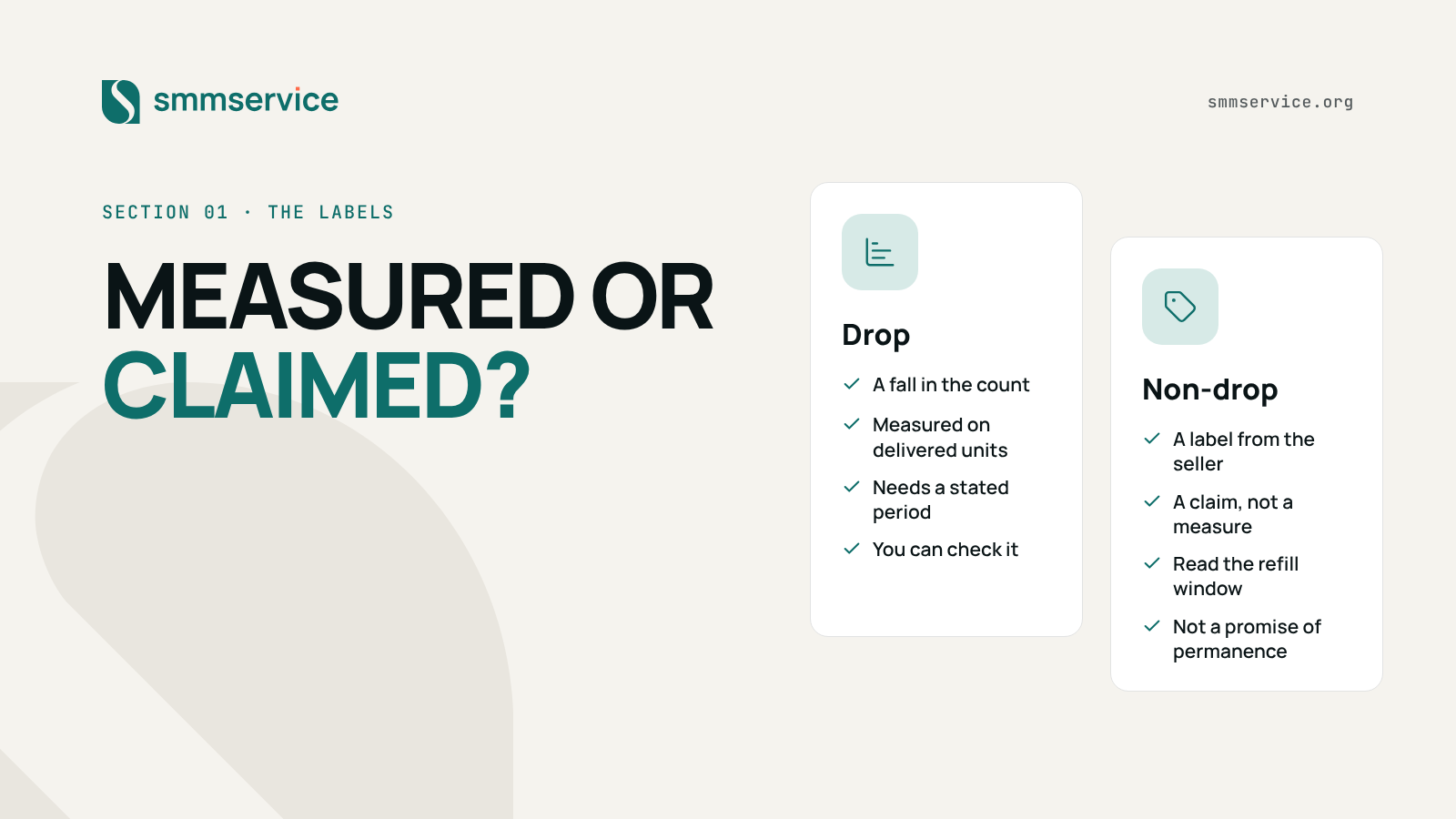
Drop describes a decline in purchased units after delivery, and non-drop describes a service sold as holding its units better. Both words come from sellers, not from platforms, so their meaning depends on who wrote them and what terms sit beside them.
What "drop" means
A drop is the loss of some of the units you bought after the order showed as Completed. If an order delivered 1,000 followers and 120 of them later disappear from the count, the order has dropped by 12%. The same idea applies to likes, views, subscribers and comments, although each behaves differently, as the service-type section below explains.
Services labeled "drop" or "high drop" are described with that expectation. They can fit short-term goals, such as making a post look active during a launch week, where long-term retention matters less.
What "non-drop" means
Non-drop means the seller expects the delivered units to stay in place for the period the service covers. Some sellers describe the method behind the label, and many do not. The word does not tell you how long the count will hold, or what happens when it does not.
That is why the label should always be read together with a refill period. A non-drop service with a stated refill window gives you a way to restore the count inside that window. A non-drop label with no window gives you only the seller's opinion.
A second meaning to avoid
Some articles use "non-drop followers" to mean real, loyal followers who keep engaging with an account. That is a different idea, about audience quality in organic growth. In this guide, drop and non-drop always refer to the behavior of a purchased service after delivery.
How a drop is measured
A drop is measured by comparing the count you still have with the count that was delivered, over a stated number of days. Retention is the share that remains, and the drop is the share that left.
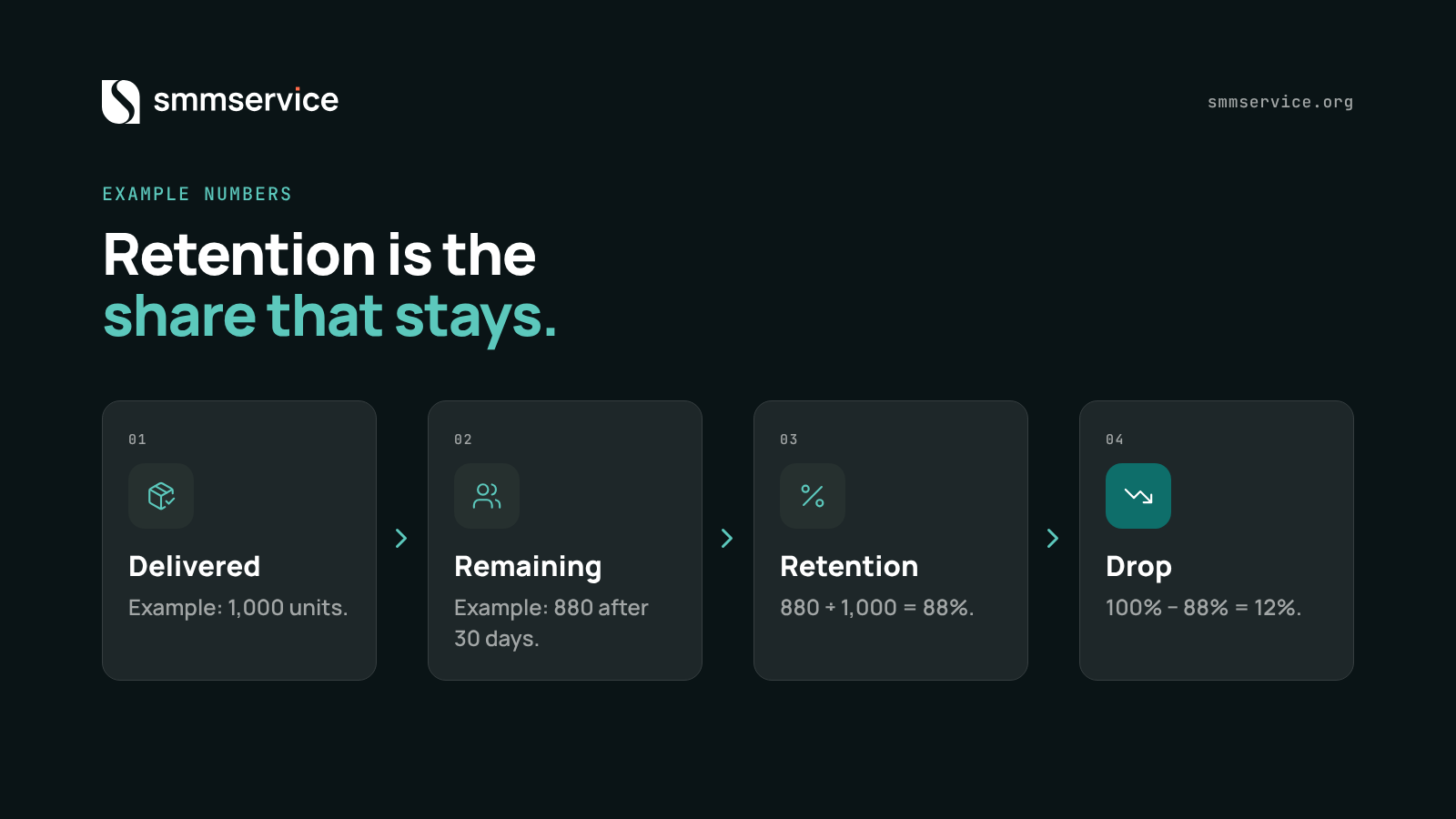
The calculation has three inputs. Delivered is the number of units the order delivered. Remaining is how many of those units are still present on a given day. The retention rate is remaining divided by delivered, multiplied by 100, and the drop rate is 100 minus the retention rate.
Example: a 30-day check
An order delivers 1,000 followers. After 30 days, 880 of them are still counted. Retention is 880 divided by 1,000, or 88%, and the drop is 12%. This is an invented example to show the arithmetic, not a result from any service.
To measure this on a real order, record the start count before delivery and the live count on each check day. The change in the live count minus the start count approximates what remains from the order. It is only an approximation if the account also gains or loses followers on its own, which is why a quiet test account gives cleaner numbers.
Why the period matters
A drop rate without a number of days cannot be compared. A 10% drop after 3 days is a very different outcome from a 10% drop after 90 days. When you compare two services, ask for the period first and the percentage second.
Counts do not always update at once
Do not judge an order by the first number you see. YouTube states that the subscriber figures in YouTube Analytics run roughly 48 hours behind the public count, because it reviews subscribers for spam before they are counted. Other platforms refresh their displays on their own schedules too, so wait a day or two before concluding that something dropped.
Why drops happen
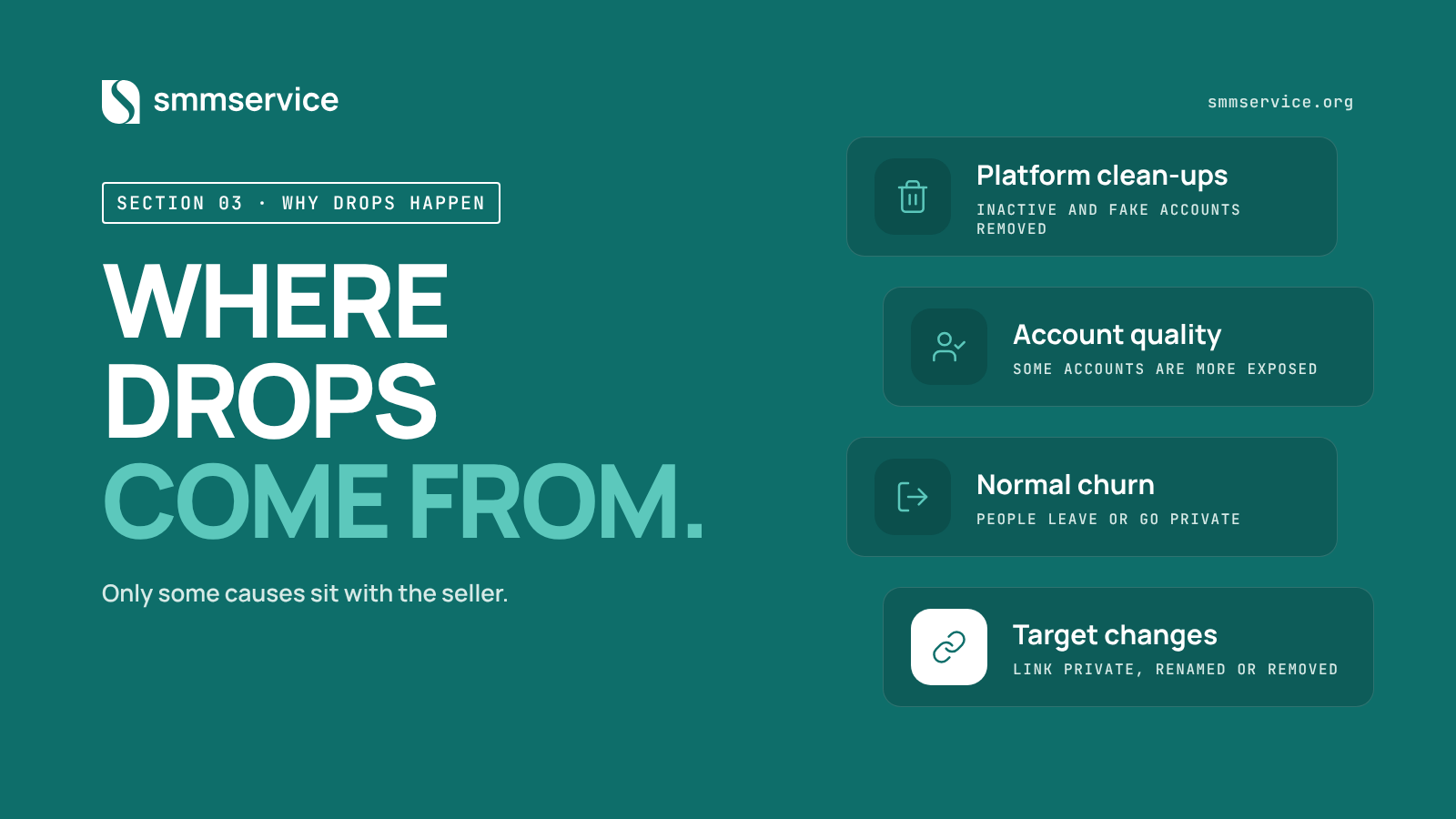
Drops come from five main causes, and only some of them sit with the seller. Knowing which cause you are looking at decides whether a refill can help.
Platform clean-ups
Platforms periodically remove inactive, spam or fake accounts, and every follower or like from those accounts leaves the count with them. This is not new. In April 2014, Instagram removed inactive and spam accounts and told users that their follower and following lists may have changed. In late 2018, YouTube removed spam subscriptions from channels, and said it expected overall watch time to stay the same.
More recent reports follow the same pattern. In May 2026, news outlets reported large follower drops on Instagram after a clean-up of bot and inactive profiles. Meta described it as routine removal of inactive accounts and said active followers were unaffected, and it did not confirm the larger figures circulating at the time. We therefore use no individual account numbers from those reports.
The platforms state their approach in writing. TikTok states that it takes down fake followers and likes tied to accounts or content whose numbers it finds inflated. YouTube leaves subscribers it flags as spam out of its totals, and Meta says its detection has to keep evolving as spam tactics change.
Account quality
Not every delivered account is equally exposed to a clean-up. Platforms target inactive and fake accounts, so a service built on accounts of that kind is more exposed than one built on accounts that behave like ordinary users. This is one reason two services for the same platform can behave differently, and why price alone says little. A 2022 analysis of reseller panels found that identical services were sold at widely different prices, which suggests that price does not reliably signal quality.
Normal churn
Real accounts also leave on their own. People go private, deactivate or delete their accounts, and these changes reduce counts even when no clean-up has run. Normal churn is small on any one day, but it adds up over a 30-day or 90-day window.
Changes at the target account
The account that received the order can also cause losses. If it changes its username, goes private, is restricted or is removed, the delivered units can fall away or the order can no longer be checked. Keep the link public and unchanged while an order and any refill request are open.
Delivery and timing
Buyers in community discussions report losing purchased followers within one to two weeks, or seeing a count spike for a day with engagement that stays low. These are individual reports, not measurements, so treat them as signals to test rather than as facts. They do support one practical point: check your counts on set days instead of relying on a single early reading.
What a non-drop label can and cannot promise
A non-drop label can promise that the seller expects the service to hold its count and that a refill window exists. It cannot promise that a platform will never remove the accounts involved. No seller controls what a platform does next.
Independent data shows how much retention varies. In a 2025 experiment published in January 2026, the NATO Strategic Communications Centre of Excellence bought likes, comments, views and followers from ten commercial providers across several platforms. After four weeks, the share of purchased engagement still present varied by platform, from about 43% on X and 56% on YouTube to about 79% on Facebook and 84% on Instagram. The study reports providers as a group, so it cannot tell us whether a "non-drop" label performed better. It does show that the platform and the service type shape retention as much as the seller does.
Warning: a label is not a guarantee
Words such as "never drop" or "0% drop" describe how a service is meant to behave. They do not stop a platform from running a clean-up. Look for the refill window and the refund terms, because those tell you what the seller will actually do.
In our experience across the SMM industry, high-quality or organic-tier engagement is never permanently 100% non-drop, because platform algorithms keep changing. Certain specialized delivery setups, such as some private network deliveries or Facebook page-based account methods, can reach near-lifetime retention. Outside those specific setups, no panel can honestly promise permanent retention.
A claim decoder
The table below turns common label wording into the question you should ask about it.
| What the label says | What it leaves open | What to ask or check |
|---|---|---|
| Non-drop | For how long, and how it is measured | The refill period in the service name or description |
| 0% drop / never drop | What happens if a platform clean-up removes accounts | Whether the terms mention platform changes as an exception |
| 30 days refill | How many refills and what voids them | Eligibility, limits and the refund terms |
| Lifetime refill | What "lifetime" means in days | The practical period and the conditions on it |
| 10-30% drop | Over what period the range applies | The period, and whether refill is offered |
| No refill / not guaranteed | Nothing; this is a clear statement | Whether the lower risk or short-term use fits your goal |
Drop vs non-drop services side by side
The two types suit different goals, so the comparison is about fit rather than which one is better. The table summarizes what to expect from each. Rates change, so they sit on the services page.
| Criterion | Drop-labeled services | Non-drop-labeled services |
|---|---|---|
| Expected behavior | Some loss of the count is expected | The count is expected to hold for the covered period |
| Refill | Often none, or a short window | Usually a stated refill window |
| Fits | Short-term visibility, testing, tight budgets | Profiles you want to keep stable, resale to customers |
| Main risk | The count falls and may not be restored | A label that promises more than the terms support |
| What to check first | The expected drop range and period | The refill period and the conditions on it |
Price is left out of the table on purpose. Research on reseller panels found that the same service is sold at very different prices, so a rate alone does not show how a service behaves. Compare the terms behind the rate.
Refill and guarantees
A refill is a replacement of units that dropped, requested inside a stated period. It is a service feature with conditions, not a guarantee that a count will stay where it is. The conditions decide its value.
Before you order a service with refill, check the following points. They apply to any panel, including ours.
- How many days the refill window lasts, and when it starts.
- How soon after completion you can request a refill.
- How many refills you can request inside the window.
- What happens if the refill cannot be completed, including any refund.
- What voids the refill, such as service outages or platform changes.
- How a request is checked, and how long that usually takes.
How refill works at SMMService
The refill window is stated in the service name and description, for example "30 Days Refill". On eligible services, a Refill button appears in the Action column of the Orders page once the order is Completed. We accept refill requests starting 24 hours after the order completes, and you do not have to wait for a specific drop percentage before asking.
Inside the window, our team actively attempts to refill dropped counts. If a refill cannot be completed, we issue a partial refund credited for the exact undelivered volume. Once a partial refund has been issued on an order, no further refills or refunds are available for that order. For the order statuses involved, see our guide on what an SMM panel is and how it works.
When a refill may fail
A refill can fail or be voided in three situations. Each one sits outside the order itself.
- The underlying service is temporarily down or unstable.
- The upstream provider updates the service, which changes the price or ends the original server route.
- The social platform rolls out a major platform-wide algorithm sweep or security update.
The third case matters most for this topic. If a platform removes a large share of accounts in one sweep, a refill can run into the same filter that caused the drop.
How a refill request is checked
Requests follow one of two routes. In a manual review, our team compares the order's start count, submission date, current live count and service terms to confirm the drop fits the terms, and then sends a confirmation that the refill is accepted. In an automated review, the request is processed by our system, routed to the fulfillment server and verified through our server maintenance partners.
What "lifetime refill" means
"Lifetime refill" follows the same mechanics as any other refill period. In the SMM industry, lifetime is practically treated as 365 days, or one year. Our support can extend beyond that as long as the underlying server route stays active.
How drop behavior differs by service type
Followers, likes, views, subscribers and comments each behave differently after delivery. The type of unit decides what a platform can remove and what you can check afterward.
Followers and subscribers sit in a list tied to an account, so a clean-up that removes an account also removes that follower. YouTube leaves out of its totals any subscribers it identifies as spam. Likes and comments attach to one post, and TikTok says it takes down fake followers and likes once it finds inflated numbers. Views are counted differently, and YouTube says page traffic found to be artificial is not counted.
The NATO experiment shows the platform effect clearly, because the same kinds of purchases kept very different shares on different platforms after four weeks. For you, the practical lesson is to test each combination of platform and service type separately. A service that holds well for one may not behave the same way for another.
Which one suits which situation
The right choice depends on how long the count needs to hold and what you plan to do with the account. Use the table as a starting point, and adjust for the platform you are working on.
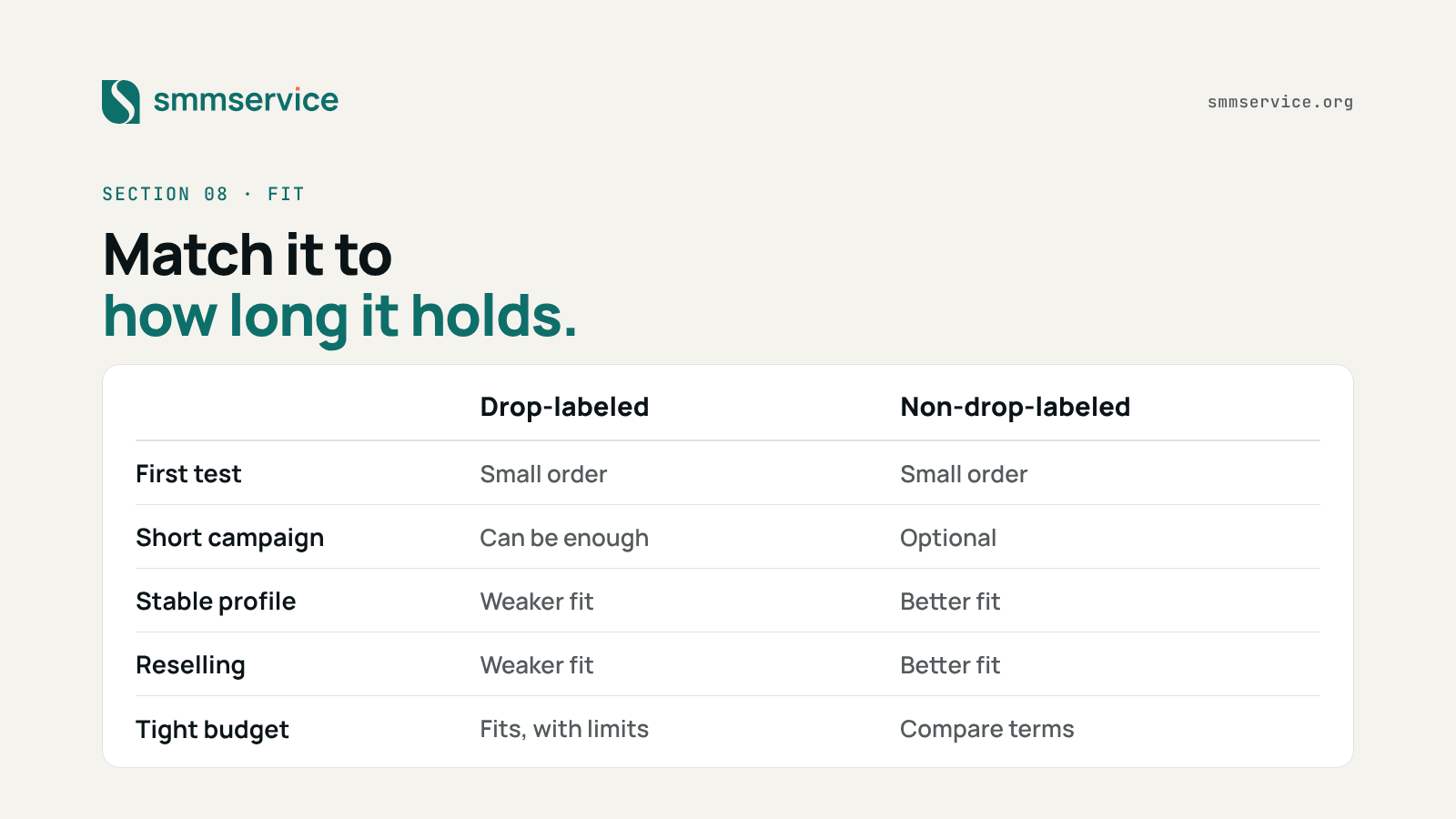
The table lists five common situations and the type that usually fits each. Read the "why" column as a reason, not a rule.
| Situation | Better fit | Why |
|---|---|---|
| First test of a new service | Either, in a small order | You are measuring behavior, not committing to it |
| Short campaign or launch week | Drop-labeled can be enough | Long-term retention matters less |
| A profile you want to keep stable | Non-drop with a refill window | The window gives you a way to restore the count |
| Reselling to your own customers | Non-drop with clear terms | You need terms you can pass on and support |
| Very tight budget | Drop-labeled, with realistic expectations | Lower cost, with the drop range understood in advance |
How to test retention yourself
You can measure a service's retention with a small order and five readings. The method costs little and gives you your own data instead of a seller's claim.
- Choose a quiet test account. Use an account that is not gaining or losing followers on its own, so your numbers stay clean.
- Record the start count. Write down the count and the date before you place the order, and keep the order ID.
- Place a small order. A small quantity is enough to see the pattern, and it limits what you risk.
- Read the count on set days. Record it when the order is Completed, then after 1, 7, 14 and 30 days, at the same time of day.
- Calculate retention. For each day, divide the change from the start count by the delivered quantity, and multiply by 100.
- Request a refill inside the window if the count fell. Note how long it took and what the result was.
Keep the readings in one simple log so you can compare them later. A start count, the delivered quantity and four readings are enough.
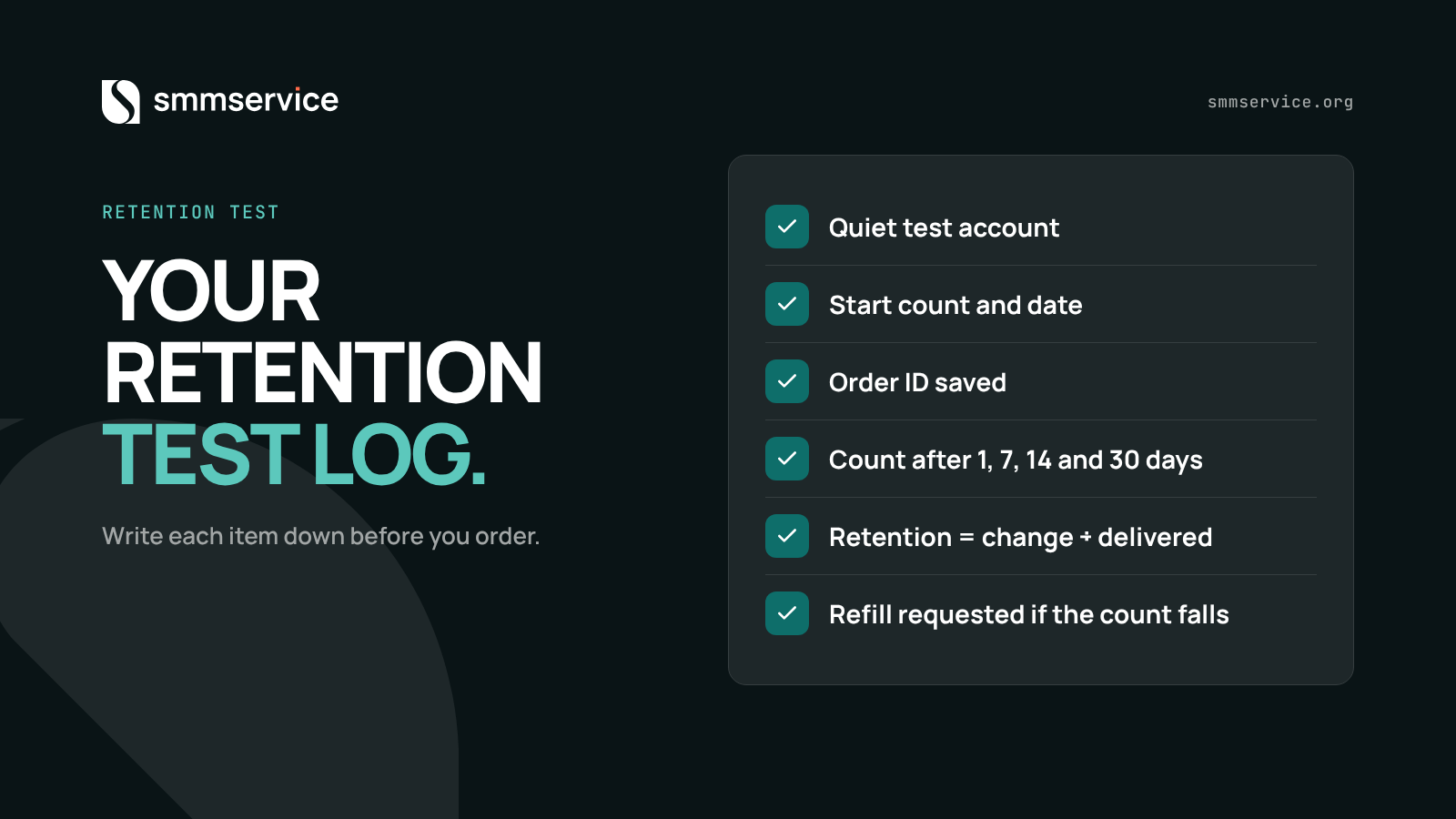
A log like this also gives you evidence if you need to ask for a refill, because it shows the dates and counts.
Tip: keep the account quiet
Avoid running other growth activity on the test account during the 30 days. If the account gains or loses followers for other reasons, you cannot tell what came from the order.
If you want to test before you deposit, you can contact our admin or support team and ask for a free test. Our minimum deposit is $1, so a first test order is also easy to fund.
For resellers and agencies: describing these services honestly
If you resell services, your customers will judge you by the wording on your service list. Clear terms protect you more than a strong claim does, because they set expectations that you can meet.
Use the refill window, not a promise of permanence. For example: "30 Days Refill: refill requests accepted 24 hours after completion." Give the period, the earliest request time and the main limits. Avoid words such as "forever" or "never drops", because they promise something you cannot control.
When a customer reports a drop, ask for the order ID and the date of completion, then compare the start count, the current count and the service terms. Explain the reason when you can, such as a platform clean-up, and apply the refill terms. The customer sees a clear process and not a debate about whose fault it is.
Be careful with descriptions that you copy from your own provider. Some panels resell inventory from upstream providers and repeat whatever the description says, and that text may not match how the service behaves. Ask your provider how they know a service performs as described, and test it yourself before listing it. At SMMService, if a customer asks about a service in the catalog, including an older one, we examine the live route and give an honest assessment.
Common mistakes and myths
Most disappointment with drops comes from a few repeated mistakes. Avoiding them is often worth more than choosing a different label.
- "Non-drop means permanent." No label stops a platform from removing accounts. Read the refill window.
- Judging the order after an hour. Displays can lag, and early readings change. Check on set days.
- "A low price always means poor quality." Price alone does not show quality, in either direction. Compare the terms and test.
- Comparing percentages without periods. A drop rate has meaning only with a number of days.
- Mixing up count and engagement. Buyers in community discussions report that purchased followers do not engage, so a stable count does not mean active followers.
- Ordering a very large amount at once. A small test shows how a service behaves before you commit more.
How SMMService labels and supports these services
We state whether a service is drop or non-drop in the service title and description, according to how that service works. For stable services we use terms such as Non-Drop, 0% Drop, 100% Non-Drop, Stable and Never Drop. For services that can fall we use High Drop, Low Drop, 10-30% Drop, Drop, Unstable and No Refill / Not Guaranteed.
These labels describe how a service is meant to behave, and the refill window in the title shows what we will do if the count falls. We are clear that no panel can promise permanent retention outside a few specific delivery setups. For rates, see the services page, and for help choosing, you can ask our live chat, the admin or the AI support bot.
Frequently asked questions
What is the difference between drop and non-drop?
Drop services are expected to lose some of the delivered count over time. Non-drop services are sold as holding it for the period they cover. The difference is an expectation, so read the refill window behind the label.
Is non-drop permanent?
No. A platform can remove accounts at any time, and no seller controls that. A refill window is the practical protection, because it gives you a way to restore the count inside a set period.
Why did my count change a day after the order completed?
Displays can lag behind real changes, and platforms review accounts before counting them. YouTube says its Analytics subscriber figures run about 48 hours behind the public count. Check again after a day or two before requesting a refill.
How long does a refill last?
It lasts for the period stated in the service name or description, such as 30 days. "Lifetime" is practically treated as 365 days in the industry.
Do I have to wait for a specific drop percentage before requesting a refill?
Not at SMMService. We accept refill requests starting 24 hours after the order completes, inside the refill window.
What happens if a refill cannot be completed?
We issue a partial refund credited for the exact undelivered volume. After a partial refund, no further refills or refunds are available for that order.
Does a higher price mean a lower drop?
Not by itself. Research on reseller panels found that identical services are sold at widely different prices, so a rate alone says little. Compare the terms and test a small order.
How should I test a service before ordering more?
Use a quiet test account, record the start count, place a small order and read the count after 1, 7, 14 and 30 days. Then calculate retention against the delivered quantity.
Conclusion and next step
Drop and non-drop are labels for expected behavior, and they only become useful when you pair them with a period, a refill window and your own readings. Platforms keep removing inactive and fake accounts, so any honest seller will tell you that a count can fall. What you can control is the choice of service, the size of the first order and how you record the result.
In short
A drop is a measured fall in the delivered count. Non-drop is a seller's claim. Read the refill window, test a small order and measure retention on set days.
If you want to test a service, you can create an account, make a small first order and compare your counts after 1, 7, 14 and 30 days.
Open your wholesale account
Free to join, no monthly fee. Order in the dashboard or through the API.