
Why People Use SMM Panels: Reasons, Fit and Limits
In this article
- Why use an SMM panel: the five reasons in short
- Reason 1: One account and one balance for many services
- Reason 2: Automation saves repeat work
- Reason 3: Pay-per-1,000 pricing makes small tests possible
- Reason 4: An early start for new or small accounts
- Reason 5: A supply layer for resellers, agencies and panel owners
- Doing it by hand or hiring an agency instead
- Which situation fits
- When a panel is not the right choice
- Risks to weigh and how to limit them
- Seven questions to ask yourself before you use one
- How to start with a small test
- Where SMMService fits
- Frequently asked questions
- Conclusion and next step
Why use an SMM panel? People ask because a panel looks like a shortcut, and a shortcut deserves a close look before you spend money on it. An SMM panel is a website where you buy social media services, such as followers, likes and views, from one prepaid balance. The real question is whether that setup solves a problem you actually have.
This guide gives the five reasons people use panels, shows what independent evidence supports each one, and says when a panel is the wrong tool. It is written for newcomers: buyers, business owners and agencies who want to decide before they commit.
Short answer: People use an SMM panel for five reasons. These are one account for many services, less repeat work, per-1,000 pricing that allows small tests, an early start for new accounts, and a source of supply for reselling. Independent evidence supports the practical reasons better than the early-start idea, which rests on one narrow experiment. A panel suits buyers who can check results over several weeks. It does not suit anyone who needs a quick fix for weak content.
Key takeaways
- The strongest reasons to use a panel are practical: one balance, less manual work and small, cheap tests.
- The early-start reason is the weakest: the one field experiment we found shows the first like on an ad helps, and extra likes do not raise clicks.
- Resellers and agencies use a panel as a supply layer, but margins depend on hidden costs such as support time.
- Test with a small order, record the count before you start, and check again after 1, 7 and 30 days.
Why use an SMM panel: the five reasons in short
People use panels for five distinct reasons, and each one helps a different kind of buyer. Knowing which reason applies to you is the quickest way to decide whether a panel fits.
| Reason | Helps most | Independent evidence | Strength |
|---|---|---|---|
| 1. One account, one balance | Buyers and agencies | A catalog study of 86 panels shows how many service variants exist and how they differ | Moderate: it describes catalogs, not buyer outcomes |
| 2. Less repeat work | Agencies and resellers | Surveys show social teams lack time; developer tools show orders and statuses handled by software | Indirect: nothing measures panel automation itself |
| 3. Small tests at per-1,000 prices | Newcomers | The same study found identical products at noticeably different prices; forum advice favors small first orders | Moderate for price spread, anecdotal for testing |
| 4. An early start | New and small accounts | One ad experiment, plus platform pages that describe no rule for new accounts | Weak: purchased engagement was not tested |
| 5. A supply layer | Resellers, agencies, panel owners | Security-research talks, developer tools and agency benchmarks | Moderate for structure, none for panel margins |
The strength column matters as much as the reasons. A reason with weak evidence can still be worth testing, but you should test it, not assume it.
Reason 1: One account and one balance for many services
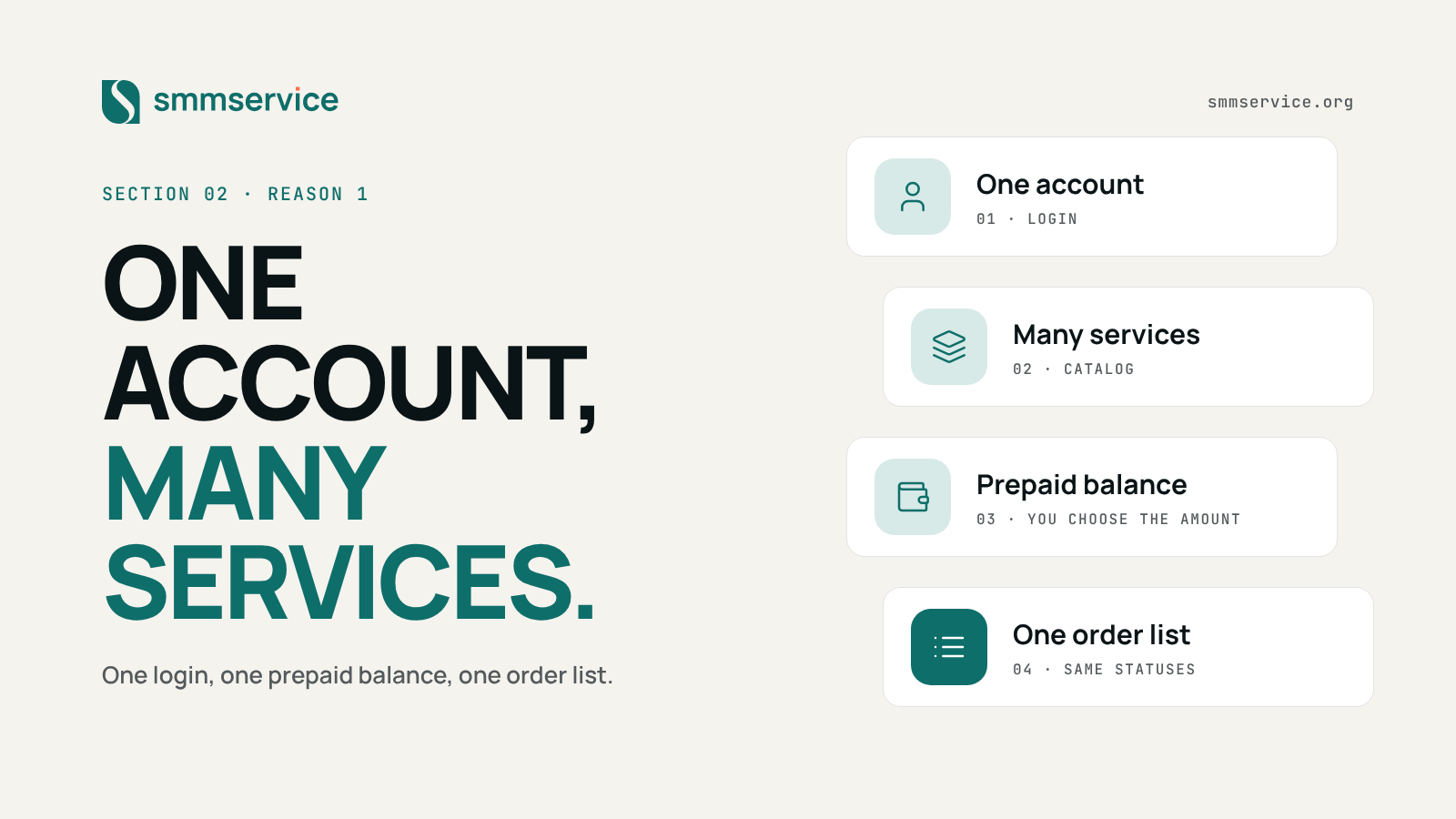
The first reason is convenience. A panel puts many services behind one login and one prepaid balance, so you do not manage a separate seller for each platform and service type.
A 2022 academic study by Nevado Catalán and colleagues shows why this matters. The researchers crawled 86 panels every day for four months and collected 2.8 million catalog entries. Those entries collapsed into about 61,000 distinct services, because the same basic service appears in many variants. Buyers could choose attributes such as speed, quality and the country of the accounts involved.
With that much variety, a single catalog saves real effort. You compare options in one place, see every order in one list, and read statuses that follow one pattern. You also top up once, not several times.
The limit is honest and simple. One account makes services easier to manage, not better. Security researchers describe panels as a layer between providers and buyers, so a weak provider behind the catalog still affects your result. Convenience is a good reason to use a panel. It is not proof of quality.
Reason 2: Automation saves repeat work
A panel handles the routine parts of buying: taking the order, passing it on, tracking its status and adjusting your balance. If you place similar orders often, that removes repeat work.
What the panel automates
A panel order has three inputs: a service, a link and a quantity. Developer tools show what the software handles after that. An open-source client for panel APIs lists actions to list services, add an order, check one status or many, request a refill, cancel and read your balance. A WordPress plugin forwards store orders to a panel API, tracks status and balance, and flags failed orders.
For an agency or reseller this is the useful part. A connected store sends orders to the panel without anyone copying details by hand, and a failed order shows up in a list instead of a customer complaint.
Note: a panel is not a login-based tool
A 2018 study of Instagram services separated tools that act as you after you hand over your login from services that sell counts. A panel order takes a service, a link and a quantity. If an order form asks for your password, treat it as a different kind of service.
What still needs a person
A panel does not choose the service for you, check the result or answer your own customers. Those jobs stay with you. It also does not schedule posts, write captions or reply to comments.
The workload data explains why the saved hours still count. Sprout Social, a social media software company, asked over 500 marketers in the US and UK about their workload. Close to half of them (48%) said they only sometimes or rarely have the time to get everything done. A 2026 Sprout report, cited in an August 2026 article, found that most working time for 80% of individual contributors goes to operational tasks. These figures describe social teams in general, not panel users. They show that routine hours are scarce, and a panel only removes the ordering part of them.
Reason 3: Pay-per-1,000 pricing makes small tests possible
Panels price services per 1,000 units, so the charge follows the quantity you order. You can start with a few hundred units, and a prepaid balance means you decide how much to put in.
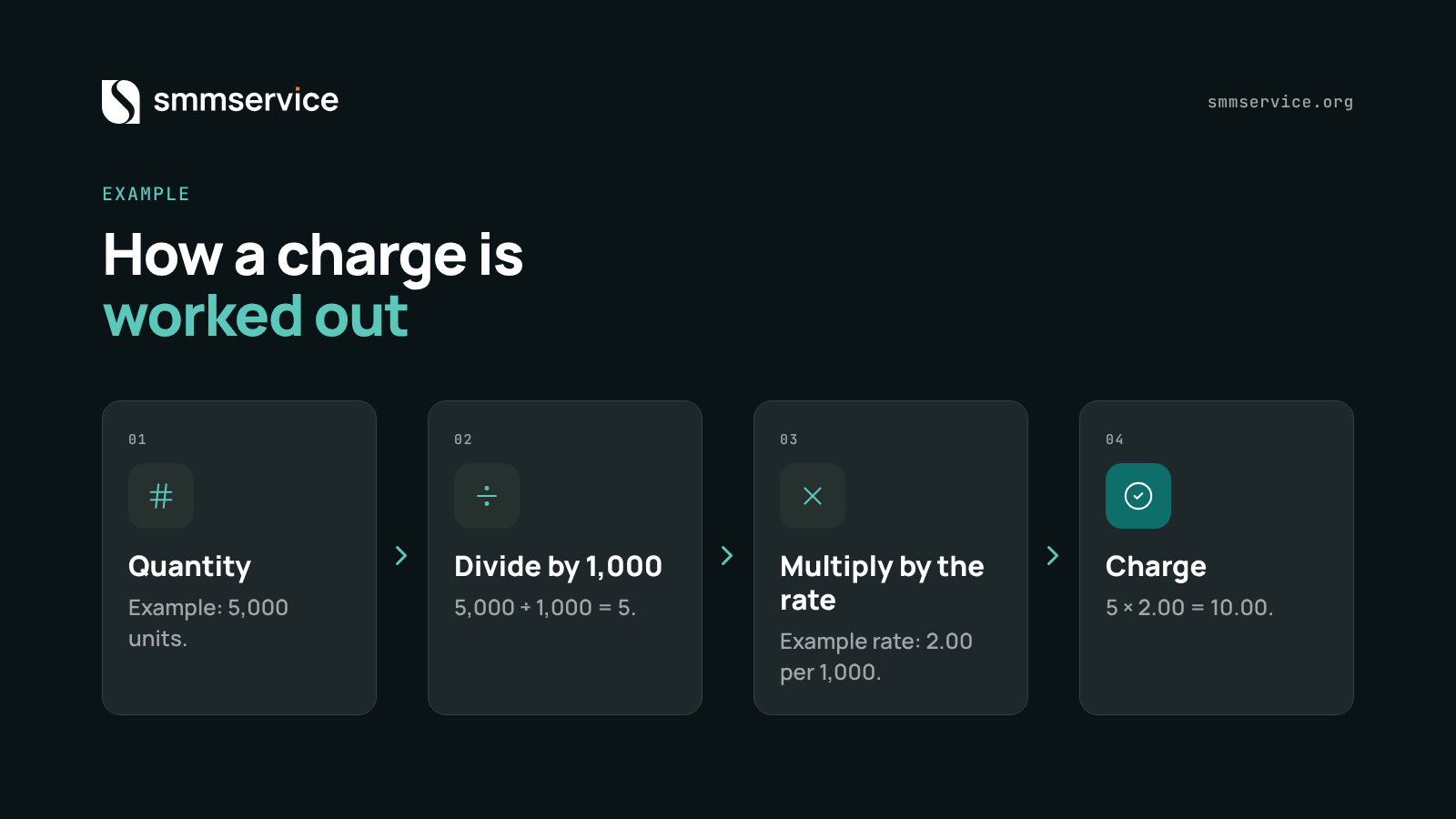
The formula is short: charge = quantity ÷ 1,000 × rate. The table below applies it to an invented rate of 2.00 per 1,000 units.
| Example order | Calculation | Charge |
|---|---|---|
| 500 units | 500 ÷ 1,000 × 2.00 | 1.00 |
| 5,000 units | 5,000 ÷ 1,000 × 2.00 | 10.00 |
| 20,000 units | 20,000 ÷ 1,000 × 2.00 | 40.00 |
Example: the rate above is invented to show the arithmetic. Real rates change, so read them on the SMMService services page before you order.
A small first order limits what you can lose and still tells you a great deal. You see how fast the order starts, what the status does and how the count behaves a week later. A larger order tells you the same things at a higher cost.
Prices also differ between panels. The same 2022 study found that identical products sold at noticeably different prices across panels, and that some panels offered free trials. Compare the rate with the limits, the refill terms and the support, because a low rate alone says nothing about delivery. A community discussion on HubSpot's forum repeats the same advice: start with small test orders and be wary of offers that promise to be both extremely fast and extremely cheap. Most panel recommendations in that thread come from members with no disclosed ties, so we use the advice and ignore the names.
Reason 4: An early start for new or small accounts
The early-start idea says that visible engagement on a new account gives it a first signal that makes other people more likely to engage. The idea is plausible, but the evidence for it is narrow.
The main test we found is a field experiment by Song Lin and Shan Huang, published in the Journal of Marketing in 2025. Users were randomly shown a social ad with no likes, one like, or all the likes it had gathered organically. Across 82 different ads, the team measured over 5.5 million impressions. One visible like raised likes and clicks by nearly one percentage point. Further likes kept raising the number of likes but did not raise clicks. Lesser-known brands gained more than well-known ones. You can read the American Marketing Association summary of the paper.
Warning: one experiment is not a rule
The study tested organic likes on ads. It did not test purchased engagement, new accounts or reach, and the summaries we read disagree on which platform it used. It suggests a first like can help an unknown brand. It does not show that bought likes raise reach, sales or trust.
The platforms themselves say little about new accounts. Instagram's 2023 explainer Instagram Ranking Explained says there is no single algorithm. Each surface has its own ranking, popularity matters more in Explore than in Feed, and Reels considers details about the poster such as followers or engagement. YouTube's help page How YouTube recommendations work lists watch history, search history, subscriptions, likes and satisfaction surveys as signals. Neither page describes a rule that new accounts need early likes.
Treat this reason as a hypothesis. If you test it, measure something that matters to you, such as reach, profile visits or link clicks, before and after. A panel cannot fix weak content. If the content is not worth clicking, a higher count only shows more people a profile they have no reason to follow.
Reason 5: A supply layer for resellers, agencies and panel owners
Resellers and agencies use a panel as the supply side of their own business. They buy at the provider's rate, sell at their own rate and keep the difference. This is the reason with the clearest structure behind it.
Security researchers described this chain in conference talks in 2018 and 2019: a main provider, bulk reseller panels, resellers and end customers. They also noted that panel software exposes an API for receiving and passing on orders. Today's tools still follow that pattern. A WordPress plugin connects a store to a panel API. A buyer's 2026 job post for panel development asks for a prepaid balance, a catalog, order tracking, support tickets, admin margin settings and connections to provider APIs.
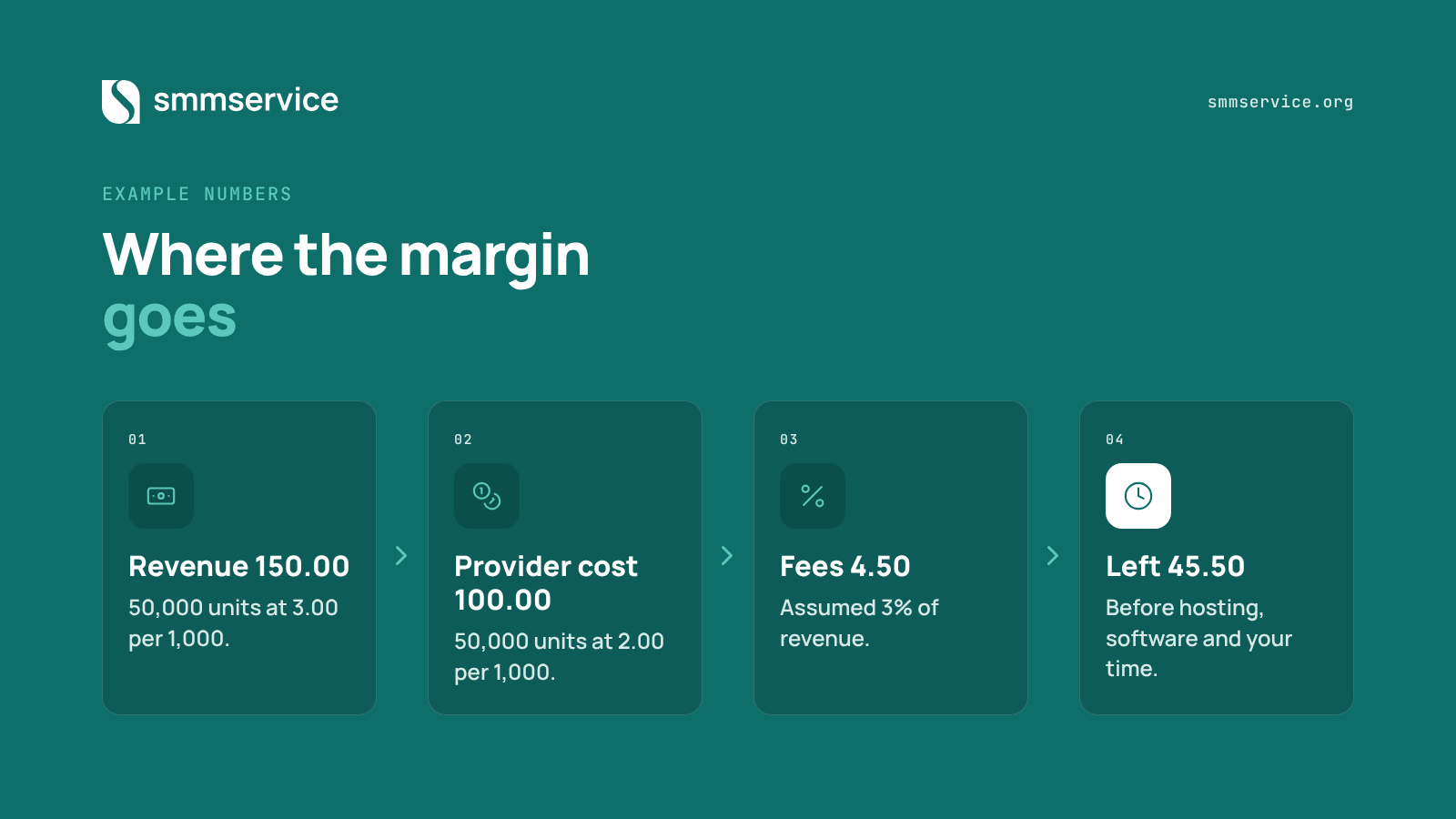
The table shows a margin sketch with variables you can replace. Every number is invented.
| Example line | Value |
|---|---|
| Provider rate per 1,000 units | 2.00 |
| Your retail rate per 1,000 units | 3.00 |
| Units sold in a month | 50,000 |
| Revenue (50 × 3.00) | 150.00 |
| Provider cost (50 × 2.00) | 100.00 |
| Gross margin | 50.00 |
| Payment fees, assumed 3% of revenue | 4.50 |
| Left before hosting, software and your time | 45.50 |
The sketch leaves out the biggest cost: your time. Answering customers, fixing failed orders and chasing refills all happen after the margin line. Agency benchmarks show how quickly time consumes revenue. The Moore Kingston Smith 2025 survey of UK marketing services companies put the average operating profit margin at 10.2%, with staff costs at 61.8% of gross income. The BenchPress 2025 survey reported that gross margins for agencies above 1 million GBP fell to 39% in 2024, the lowest on record. These are marketing agencies, not panel resellers, and we found no independent data on panel reseller margins. They still show that thin margins are normal when people do the work.
Upstream reliability sets your margin as much as your price does. If a provider is slow or an order fails, your customer contacts you, not the provider. For an agency, the practical rule is to choose a provider on delivery and support first, and rate second.
Doing it by hand or hiring an agency instead
A panel sells units of activity. A freelancer or agency sells strategy and managed work. The two solve different problems, so the comparison is about control and the cost of time, not about which is cheaper.
Doing it by hand
Organic work costs time, not money. You write the posts, answer the comments and build the audience yourself. A panel does not replace that work. At most it supports one part of it, such as a test order beside your own content.
Hiring a freelancer or agency
You pay for strategy, content, reporting and a person who is accountable for the result. AgencyAnalytics, which sells agency software, lists the costs an agency carries: labor, software, overhead and client-specific work. Labor is the largest. That is why managed services cost more than a prepaid balance, and why a panel cannot replace them. If you want someone to plan and run your presence, you need a person, not a catalog.
This guide leaves paid advertising out. It is a different thing to buy and needs its own comparison.
Which situation fits
The decision depends on your goal, your ability to check results and who relies on the numbers. Start from your situation and read across.
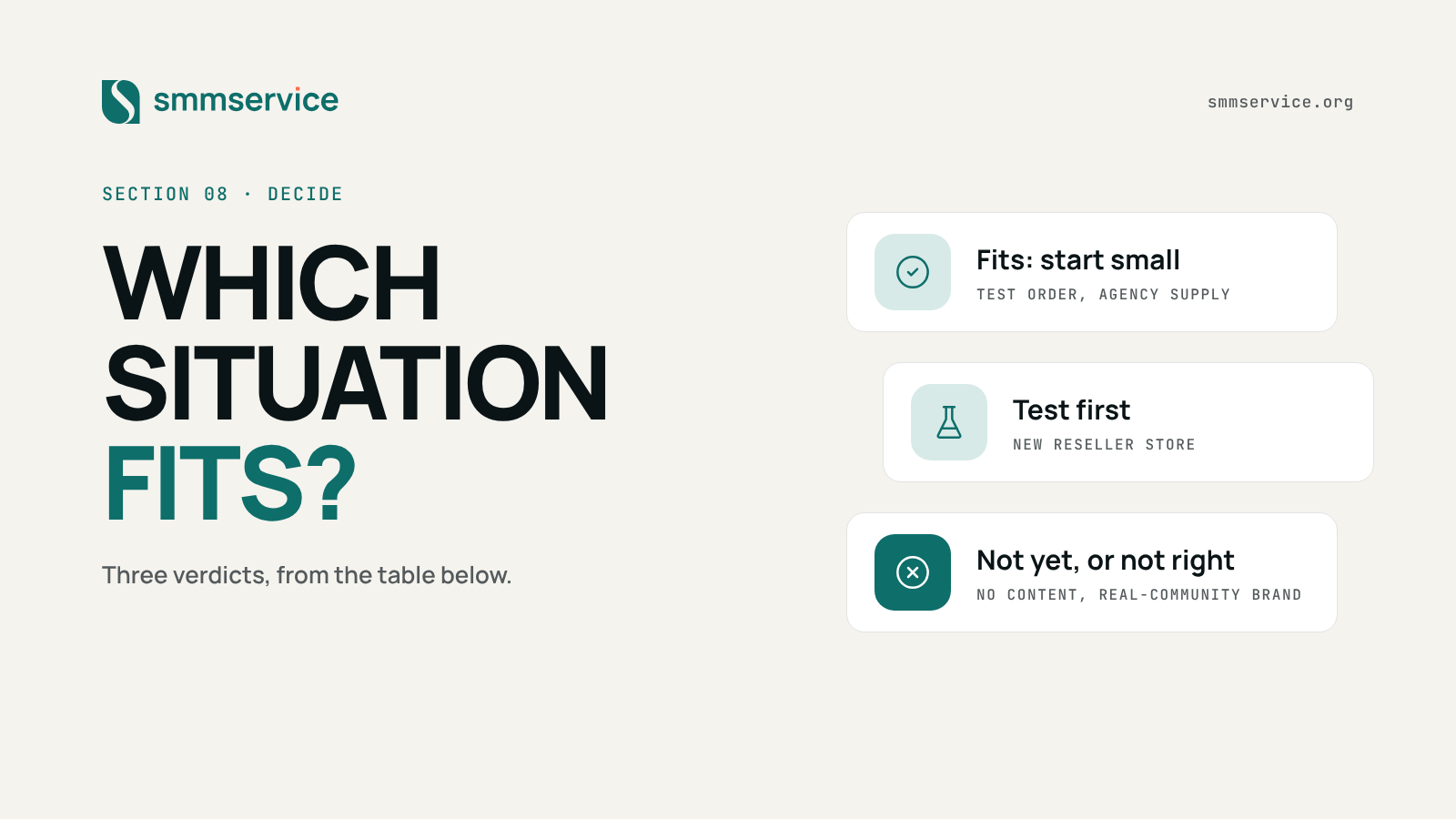
The table gives a verdict for common situations. It is our own framework, built from the evidence above.
| Your situation | Verdict | Why |
|---|---|---|
| You want to try a service cheaply before committing | Fits: start small | Per-1,000 pricing makes a test order inexpensive |
| You run an agency and need a supply source behind your own services | Fits, with checks | You need delivery and support you can rely on for your customers |
| You want to open a reseller store | Test first | Model your hidden costs and time before you set a retail rate |
| You have a new account with no content and no plan | Not yet | The one study found likes do not raise clicks beyond the first |
| Your brand depends on a trusted, real community | Not the right choice | Counts do not show who is a real person |
| You cannot check the results over several weeks | Not yet | Retention is only visible over time |
Notice what the table does not say. No situation gives a panel a promise of results. It only says where a panel fits as a tool.
When a panel is not the right choice
A panel is the wrong choice when the numbers must represent real people, or when the content or the plan is not ready. Several cases come up often.
- Weak content. The field experiment found that extra likes add little to clicks, and the effect weakens as likes accumulate. Better content works on the part a panel cannot touch.
- A brand that depends on a real community. A 2018 study found that profile features such as follower counts barely separate accounts that bought followers from random users, so a high number does not show a real audience.
- Zero tolerance for drops. Counts can fall after delivery, as the risks section shows.
- No time to verify. If nobody checks the count after the order, you will not know what you bought.
- Promising results you cannot verify. If you resell, your customers hold you to the outcome, not the provider.
Risks to weigh and how to limit them
The main risks are uneven delivery, counts that fall over time, statuses that report less than they seem to, and extra support work. You can limit each one with simple checks.
Delivery and retention vary
The NATO Strategic Communications Centre of Excellence repeated an experiment in 2025 and published it in January 2026. It bought engagement from ten commercial providers across seven platforms. Four weeks later, the share of engagement still online ranged from about 43% to about 84%, depending on the platform. The share delivered within 72 hours fell from about 96% in 2024 to about 76.5% in 2025. The report's TikTok figures are inconsistent between its table and its text, so we cite only the overall range.
An older study gives a similar signal. A 2018 analysis of Twitter customers found that 16.8% of them lost followers during one observed week. The platform and year differ, so read it as a reminder that counts move, not as a current rate.
Completed is a report, not a count
A status such as Completed is the panel's report about an order. It does not prove how many units are still on your account weeks later. On SMMService's Orders page the statuses are Pending, In progress, Completed, Partial, Processing and Canceled, and the page shows the start count and the remaining quantity for each order. Compare your own count with those figures instead of relying on the status alone.
Tip: write down the count first
Take a screenshot of the follower, like or view count before you place the order. Without a starting number, you cannot tell later what was delivered and what has dropped.
Support work lands on you
If you resell, a failed or slow order becomes your customer's question. Budget time for it in the margin sketch above, and choose a provider with support you can reach quickly.
Seven questions to ask yourself before you use one
These questions turn the evidence into a quick self-check. If you answer no to more than two, fix those points before you spend anything.
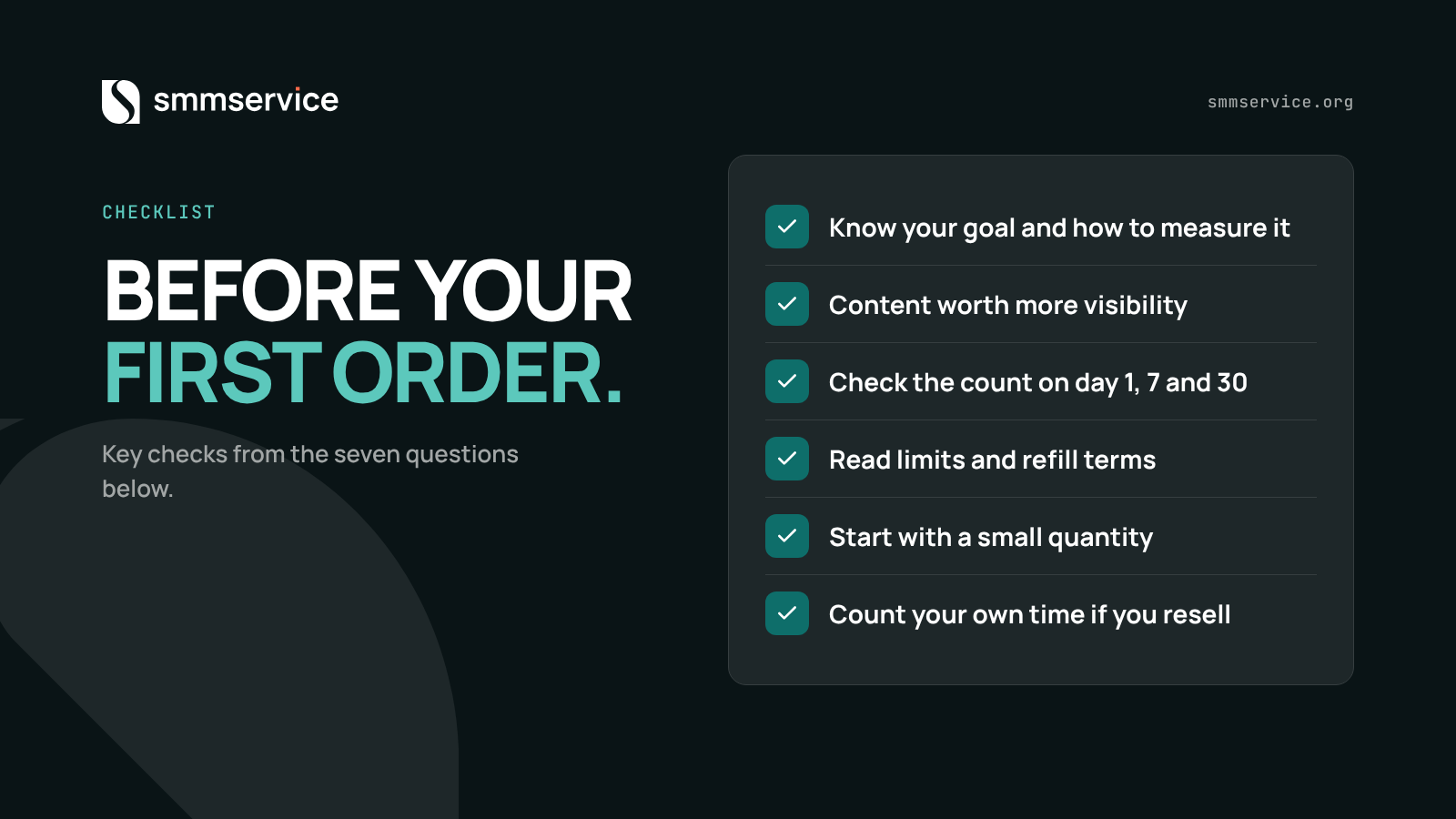
Read each question as a yes-or-no test and write your answers down.
- Do I know what result I want, such as reach, clicks or sales, and how I will measure it?
- Is my content or offer good enough that more visibility would help?
- Can I check the count again after 1, 7 and 30 days?
- Have I read the service description, including limits and refill terms?
- Am I starting with a small quantity that I can afford to lose?
- If I resell, have I counted my own time and support work in the price?
- Would I be comfortable explaining my numbers to a customer or partner?
How to start with a small test
A small test is a fixed process with a written goal, a small quantity and checks on set days. It costs little and tells you whether a service behaves the way its description says.
- Write the goal. Note what you expect, for example more visible activity on one post, and what you will measure.
- Choose one platform and one service. Read the description for limits, start time and refill terms.
- Pick a small quantity. Use the formula from Reason 3 to see the charge before you pay.
- Record the starting count. Take a screenshot of the current number.
- Place the order with your link and watch the status. Note when it moves from Pending to In progress to Completed.
- Check on day 1, day 7 and day 30. Compare the count with your screenshot and look at the quality of what arrived. If the service offers a refill and the count has dropped, use it within the refill period.
- Decide. Repeat the order, switch to another service or stop. Only increase the quantity after the day-30 check.
The day 1, 7 and 30 checks are our own method. They follow the pattern in the NATO experiment, which looked at engagement again after four weeks, and the community advice to start small.
Where SMMService fits
SMMService is a primary provider and wholesale service supplier. It serves regular buyers, business owners and other SMM panel operators.
For first-time buyers
As of October 2026, the catalog lists more than 5,000 services, updated daily. The minimum deposit is $1. Deposits, order processing and routing are automated, and orders go to the server as soon as you place them. On eligible services, Cancel and Refill buttons appear on the Orders page. Cancel works while an order is Pending, Processing or In progress. Refill works after an order is Completed and a service-specific cooldown has passed.
If you want a free test or trial before depositing, you can ask the admin or the support team directly. Support runs through live chat, direct access to the admin and an automated AI support bot. If you cannot find a service, the team can source it and add it, and complete beginners get foundational guidance. Browse the options on the services page.
For resellers and agencies
The API uses the v2 format. The documentation is public at smmservice.org/api, and you generate an API key after you log in to your account. It is meant for panel owners who run their own business and resell the catalog, not for ordinary retail use. API users get custom discounted rates below the public pricing, and higher volume unlocks larger discounts. API clients also get a dedicated VIP support group with 24/7 support.
For future panel owners
SMMService acts as the parent for child panels. A reseller, aspiring panel operator or entrepreneur can buy a turnkey child panel hosted by SMMService. It runs as an independent SMM panel website with the SMMService name white-labeled. You keep full administrative control and manage your own customers, while back-end fulfillment routes through the parent site. Child panel clients receive dedicated priority support, custom discounted rates, payment bonuses, flexible payment methods and a business setup guide.
Clients tell us they choose SMMService for affordable wholesale pricing, reliable services and support that answers with direct expertise and a friendly tone and works to resolve issues.
Frequently asked questions
Is an SMM panel worth it for a beginner?
It can be, if you treat it as a test and not a plan. A small order shows how a service behaves for little money. It is not worth it if you expect a panel to replace content, strategy or the time needed to check results.
Do SMM panels work if my content is weak?
They can raise a number, but a higher number does not give people a reason to follow or buy. The field experiment we cited found that extra likes stopped raising clicks. Improve the content first.
Do I need to give a panel my password?
A panel order takes a service, a link and a quantity. If a form asks for your password, it is a different kind of service, and you should treat it with more caution.
Can I use a panel to start a reselling business?
Yes, resellers and agencies do. Model your costs first, including payment fees and the time you spend on support, because those decide whether the margin is worth the work.
How much should a first test cost?
As little as lets you see the result. Use the formula quantity ÷ 1,000 × rate to see the charge before you order. At SMMService the minimum deposit is $1, and you can ask the admin or support for a free test.
Why does the same service cost different amounts on different panels?
Researchers who crawled 86 panels found identical products at noticeably different prices. Panels buy from different providers and set their own margins, so compare rates together with limits, refill terms and support.
What should I check after an order is Completed?
Compare the current count with your starting count, and check again after 7 and 30 days. If the service has a refill period and the count has dropped, request a refill within that window.
In short
Use a panel for convenience, saved hours, small tests and reselling. Do not use it to cover for weak content or to prove an audience that is not there. Start small, record the count and check again over 30 days.
Conclusion and next step
Why use an SMM panel? Because for the right person it is a practical tool: one balance, automated ordering and prices that make a small test affordable. The early-start idea has the weakest support, and no panel replaces content that people want to follow.
If you want to run the small test from this guide, create an SMMService account, add the $1 minimum deposit and place one small order. Record the starting count, check it on day 1, 7 and 30, and decide from what you see.
Open your wholesale account
Free to join, no monthly fee. Order in the dashboard or through the API.