
SMM Panel vs. Meta Ads
In this article
- What each one actually buys
- How each one works
- SMM panel vs Meta ads: the criteria that matter
- How you pay
- Control and effort
- Audience targeting and reach
- Measurement and results
- Risks and limits of each
- Who each one suits
- Using both together
- A simple way to decide
- Where SMMService fits
- Frequently asked questions
- Conclusion and next step
SMM panel vs Meta ads is a choice between two different kinds of purchase, not two versions of the same one. Many newcomers treat them as rivals and ask which is "better". A more useful question is what each one actually buys, how you pay for it, and what you can check afterward.
This guide compares an SMM panel and Meta ads (the paid advertising system behind Facebook and Instagram) on the criteria that matter: goal, cost structure, control, targeting, measurement and risk. It leans on Meta's own help pages for how Meta ads work, and on independent research for how purchased engagement behaves. It is written for beginners, small business owners, freelancers and agencies.
Short answer: Meta ads buy access to people through an auction, aimed at a result you choose, such as a click, a lead or a sale. An SMM panel buys units of activity, such as likes, views or followers, on a public link you provide, at a rate per 1,000 units. Choose Meta ads when you need to reach new people and drive actions. Choose a panel when you need a small, visible, predictable amount of activity on content you already have. Many plans use both, in a sensible order.
Key takeaways
- Meta ads buy delivery to an audience through an auction. A panel buys units of activity on a link, priced per 1,000.
- With a panel you see the rate before you order and can start with a small order. With Meta ads there is no fixed price per result.
- Only Meta ads let you choose who sees your message. A panel does not target people.
- Neither one fixes a weak offer or weak content, and neither report equals business results.
- Test small, record your numbers before you start, and compare after 1, 7 and 30 days.
What each one actually buys
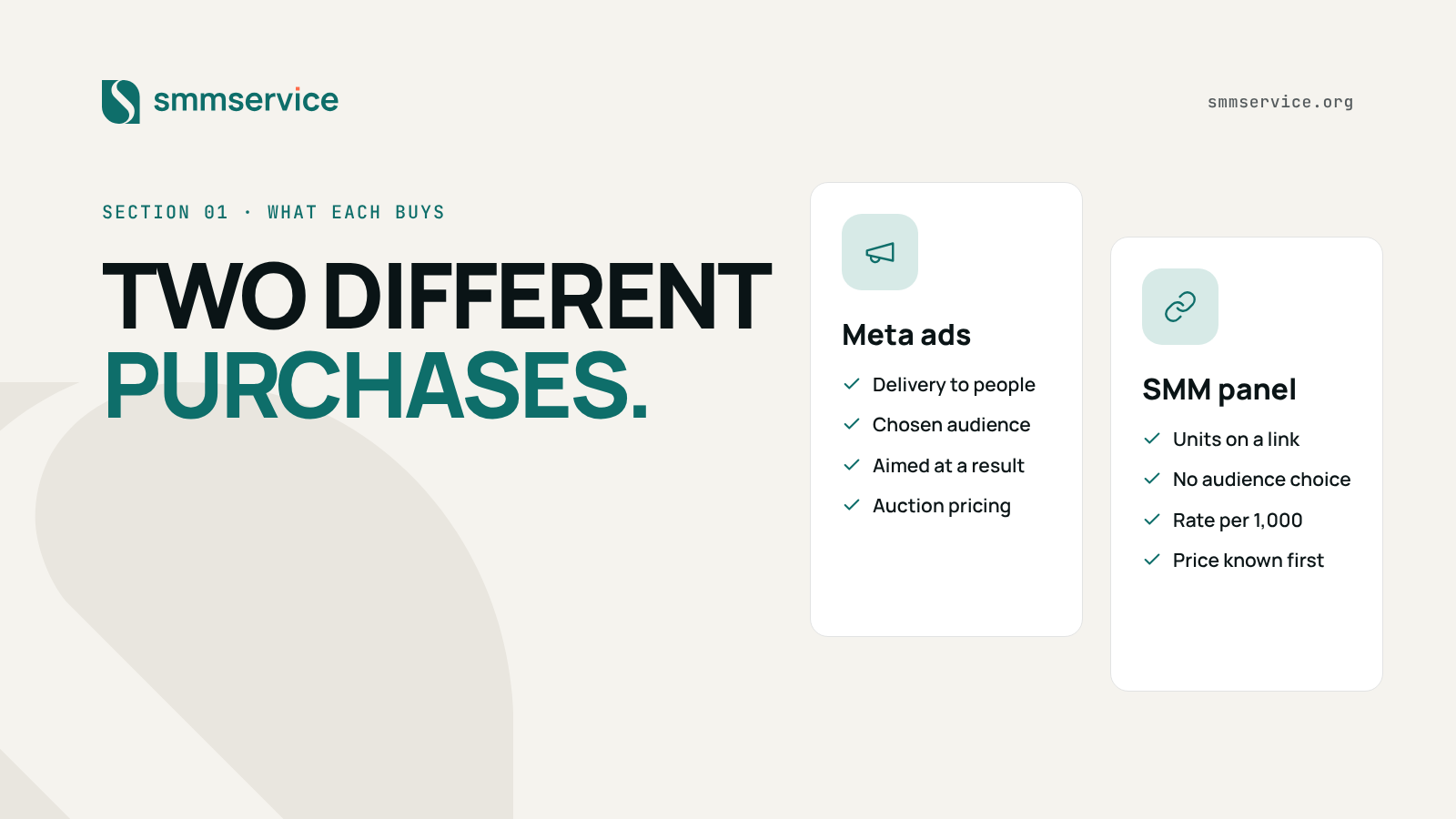
The two products sell different things. Meta ads sell the chance to be shown to people. A panel sells units of activity on a link. Everything else in this comparison follows from that difference.
Meta ads: reach to people and a chosen result
When you run Meta ads, you pay for ad delivery. You choose an objective, such as awareness, traffic, engagement, leads, app promotion or sales. You also choose an audience and a budget. Meta then decides where, when and to whom your ads appear, using an auction and machine learning.
The performance goal you pick tells the system which result to chase. According to Meta, the system bids in the auction for that outcome. If you pick link clicks, the system looks for people likely to click. If you pick purchases, it looks for people likely to buy.
SMM panel: units of activity on a link
An SMM panel is a website where you buy social media services from one prepaid balance. You choose a service, paste a public link, enter a quantity and place the order. The price is a rate per 1,000 units, shown before you order.
A panel does not choose an audience for you. It delivers the activity you ordered to the link you gave. Panel software shows this plainly. Developer tools for panels send a service, a link and a quantity. They then read back an order status, a refill option or a cancel option.
How each one works
An SMM panel order is a short, linear process that you control from start to finish. A Meta campaign has more layers, and part of the decision-making is handled by Meta's system. Seeing both flows side by side explains most of the differences in effort and predictability.
An SMM panel order, step by step
A typical order takes a few minutes. The steps below describe the general pattern, not a specific provider.
- Fund the prepaid balance. You add money to your account before ordering.
- Choose a service. Read the description for the start time, speed, minimum and maximum quantity, and whether refill is offered.
- Paste a public link. The content must be public, or the order cannot be delivered.
- Enter a quantity. The charge equals the quantity divided by 1,000, multiplied by the rate.
- Place the order and watch the status. Statuses such as Pending, In Progress, Completed or Partial show where the order stands.
The charge is known before you confirm. That predictability is the panel's clearest structural strength, and it is also why a small first order is easy to arrange.
A Meta ads campaign, from objective to delivery
Meta organizes ads in three levels. A campaign holds the objective, an ad set holds the audience, budget, placements and schedule, and an ad holds the creative. You set each level and publish, and the delivery system takes over.
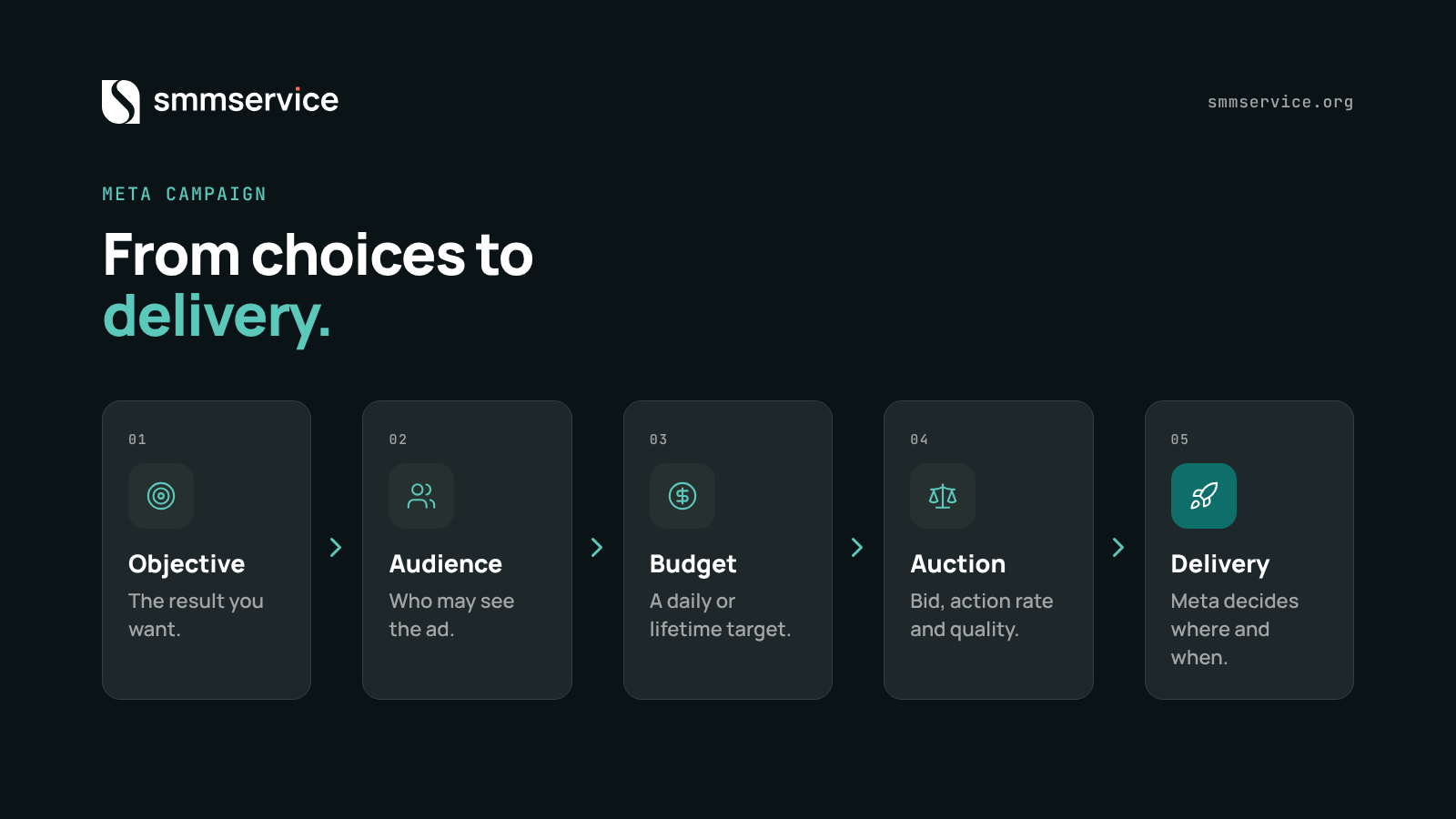
Every time someone could be shown an ad, an auction runs. Meta says the ad with the highest total value wins. Total value combines three factors: your bid, the estimated chance that the person takes the action you want, and ad quality. Because of this mix, a more relevant ad can beat an ad with a higher bid.
SMM panel vs Meta ads: the criteria that matter
Eight criteria cover most real decisions. The table gives the short version, and the sections that follow explain the reasoning and the evidence.
| Criterion | SMM panel | Meta ads |
|---|---|---|
| What you buy | Units of activity on a link | Delivery of an ad to people |
| Price model | Rate per 1,000, shown before the order | Auction; no fixed price per result |
| Audience control | None; delivered to the link | Demographics, locations, custom and lookalike audiences |
| Setup effort | Low: service, link, quantity | Higher: objective, audience, creative, budget |
| Speed to start | Orders are placed in minutes; delivery speed depends on the service | Ads need review; results stabilize after a learning period |
| Measurement | Counts and order statuses | Impressions, reach, clicks, conversions in Ads Manager |
| Main risk | Quality varies; counts can drop | Spending without results if the offer or creative is weak |
| Fits | Visible activity on existing content | Reaching new people and driving actions |
Notice that no row declares a winner. Each product is stronger on some criteria and weaker on others. The right choice depends on which rows matter for your goal.
How you pay
With a panel, you know the cost before you order. With Meta ads, you set a budget and Meta decides how it is spent. This is the biggest practical difference for a beginner.
Paying a panel: a rate per 1,000
Panel prices are quoted per 1,000 units, and the charge scales with quantity. You fund a prepaid balance and each order draws from it. Prices change, so this article shows no live prices. You can read current rates on the services page before you decide.
Independent research confirms that rates vary a lot. A study of more than fifty resale panels found that the same kind of service was sold at widely different prices. Compare the service description, not only the rate, before you order.
Paying Meta: an auction and a budget
Meta ads run on an auction, and Meta says advertisers are usually charged by impressions unless they choose otherwise when creating the ad. You set a daily or lifetime budget, and Meta spends it over the schedule. You can pause an ad at any time, and pausing stops further charges.
Budgets are targets, not exact daily limits. Meta states that on some days it may spend up to 75% more than the daily budget. The cap is 175% on any single day and 7 times the daily budget in one week.
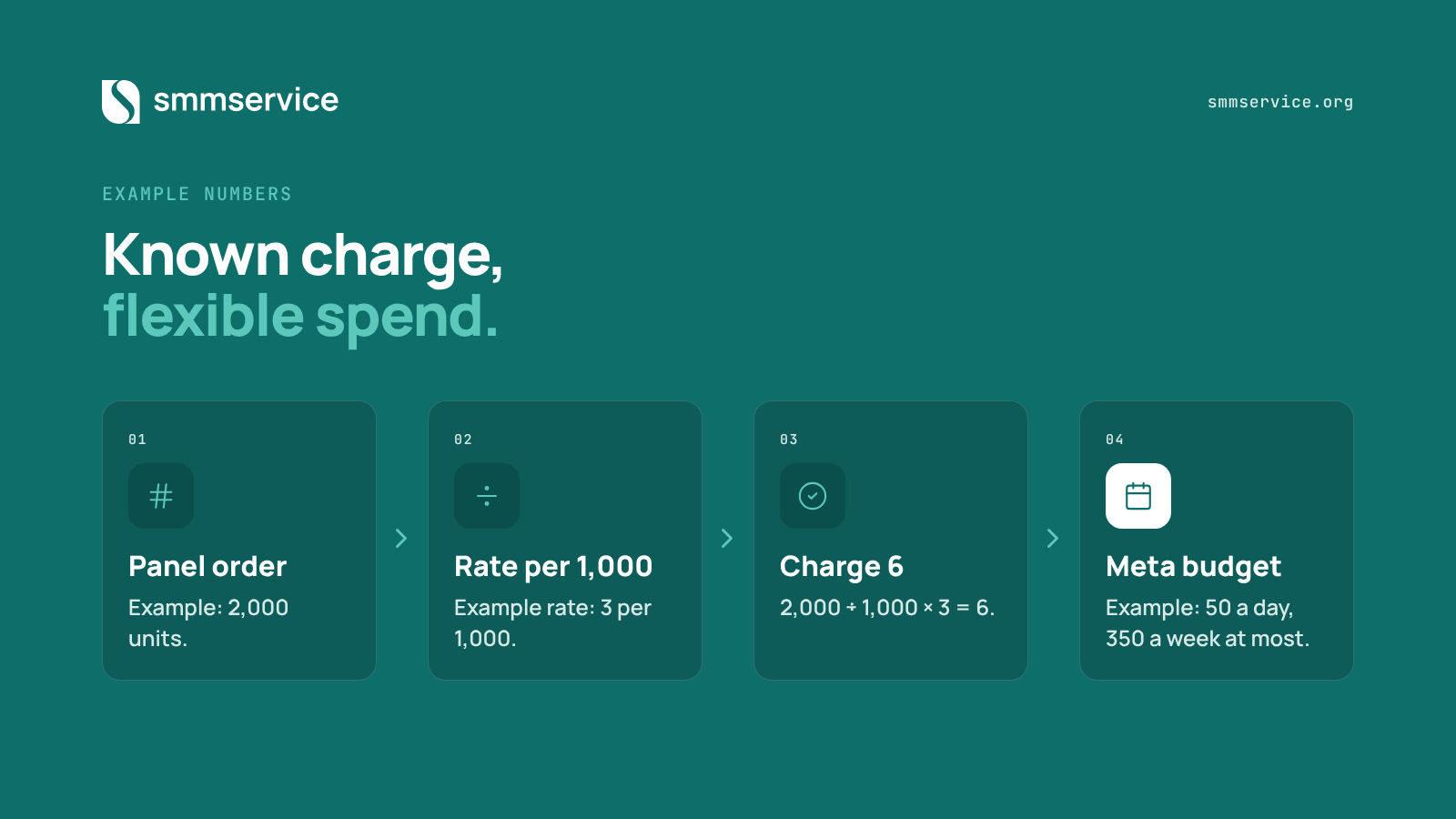
Example (invented numbers). A panel service lists a rate of 3 per 1,000. An order of 2,000 units costs 2,000 divided by 1,000, multiplied by 3, which is 6. You know the amount before you confirm. Now take a Meta ad set with a daily budget of 50. Meta says spend in a calendar week will not exceed 350, which is 7 times the daily budget. On a single day it may reach 87.5.
Tip: size a Meta budget to the goal
Meta advises a daily budget worth 10 times what one result of your goal costs on average, or more. If a link click costs 5 on average, plan for a daily budget of 50 or more. A budget far below that gives the system too little signal.
One more caution applies to billing details. In August 2025, reports said Meta had changed its billing wording. Meta then said a technical error had shown outdated information and that it had not changed its billing policies. For billing rules, rely on Meta's current help pages, not on blog summaries.
Control and effort
A panel gives you control over what you buy and when. Meta ads give you control over who sees the message, but the delivery system makes many choices afterward. Each approach asks for a different kind of effort.
What you control with a panel
You choose the service, the link and the quantity. On some services you can also spread delivery over time with drip-feed. Drip-feed splits one order into smaller runs. Guides published by panel providers describe three fields: the quantity per run, the number of runs and the interval between runs.
The total is the quantity per run multiplied by the number of runs. The span from the first run to the last is the number of runs minus one, multiplied by the interval. Example: 200 per run, 5 runs and a 6-hour interval give 1,000 units in total, with the last run starting 24 hours after the first.
Warning: check what the quantity field means
A common mistake is entering the campaign total as the per-run quantity. With 10 runs, that multiplies the order by 10. Check the calculated total and the cost before you submit.
Drip-feed controls timing only. Providers' own guides note that spacing does not improve account quality, does not secure retention and does not make an order safe from drops. Options differ by service, so read each service description.
After you order, two controls may help on eligible services. While an order is Pending, Processing or In Progress, the Orders dashboard may show a Cancel button. Once an order reaches Completed on a refill-enabled service, a Refill button may appear. Both depend on the service, so check the service before you order.
What you control with Meta ads
You control the objective, audience, creative and budget. The effort is front-loaded: you need a clear offer, a landing page or destination, and creative that people respond to. After publishing, Meta warns against frequent edits, because significant changes can restart the learning phase.
The learning phase is the period when Meta's system is still working out how an ad set should deliver. Meta says an ad set usually exits it once it records roughly 50 results within a week of its latest major change. During learning, results are less stable and the cost per result is usually higher. An older marketing article quotes 24 to 48 hours, but Meta's current figure is the one to use.
Audience targeting and reach
This is where Meta ads are clearly stronger. Meta ads let you choose who might see your message, and a panel does not. If reaching a defined audience matters to you, that difference decides the question.
Meta's developer documentation describes three kinds of targeting. Broad targeting lets the delivery system find the people most likely to respond, with basic limits such as location or age. Custom audiences are built from your own data, such as a customer list, website visitors, app events or people who engaged with your page. Lookalike audiences are built from a source group, and Meta finds similar people.
A panel works differently. It delivers activity to a link and does not select a defined audience for you. That makes a panel a poor tool for finding customers, and a reasonable tool for adding visible activity to content that already exists.
Targeting also has limits. Meta restricted certain custom and lookalike audiences that suggest sensitive information from September 2025. Strong targeting does not replace a clear offer, and a well-targeted ad with weak creative still underperforms.
Measurement and results
Meta ads come with detailed reporting, while a panel reports counts and order statuses. Neither tells you whether the business result you care about happened. The table shows what each report can and cannot tell you.
| Report | What it shows | What it does not show |
|---|---|---|
| Ads Manager | Impressions, reach, clicks, results for your chosen goal, cost per result | Whether the results were the quality you wanted |
| Panel order page | Order status, start count, remaining count, quantity delivered | Whether activity lasts, or whether it brought customers |
| Your own check | The public count on the post or profile, before and after | Anything outside the public numbers |
The goal you choose shapes what you get. An independent Meta advertising educator makes this point repeatedly: the system delivers the action you select, even when that action is not the one that matters to your business. Engagement-focused goals count volume, not the quality of the people behind it.
Meta changed what counts as a click in 2026
In March 2026, Meta announced changes to attribution for campaigns optimizing for conversions. Click-through attribution now counts link clicks only. Likes, shares and saves moved into a separate engage-through window. Trade press reported that click-through conversions might look lower in Ads Manager after the change.
Meta's help page lists three standard windows. Click-through covers 1 or 7 days after a link click. View-through covers 1 day after an impression. Engage-through covers 1 day after any other click action on the ad, such as a like or comment. Some accounts may still use earlier versions while the change rolls out.
Note: compare like with like
Do not compare results from before and after the change without checking the attribution setting. Different settings can produce different numbers for the same activity.
Risks and limits of each
Both products have real limits, and a fair comparison states them. The risks differ in kind: Meta ads can spend without results, while panel orders can deliver activity that fades or arrives incompletely.
Risks of Meta ads
- Spend without results. A weak offer, weak creative or a mismatched landing page produces clicks that do not convert.
- The learning phase. New or heavily edited ad sets are less stable and cost more per result at first.
- Competition in the auction. Other advertisers target the same people, which affects delivery and cost.
- Optimizing the wrong goal. The system delivers what you ask for, not what you meant.
Risks of an SMM panel
- Quality varies. Services with the same name can behave differently.
- Counts can drop. In a 2025 test by a NATO research center, purchased engagement still visible after four weeks ranged from about 43% to 100% depending on the platform. For Facebook it was about 79%, and for Instagram about 84%.
- Delivery can be incomplete. The same test found that the share of purchased engagement delivered within 72 hours fell from about 96% in 2024 to about 76.5% in 2025.
- It does not bring sales on its own. Activity on a link is not a customer.
Treat these figures as one test, not a promise about any provider. They are a reason to start small, record your counts, and use the refill period when a service offers one.
Who each one suits
Your situation points to a fit more reliably than a general ranking does. The picture and table match common situations to a sensible starting point.
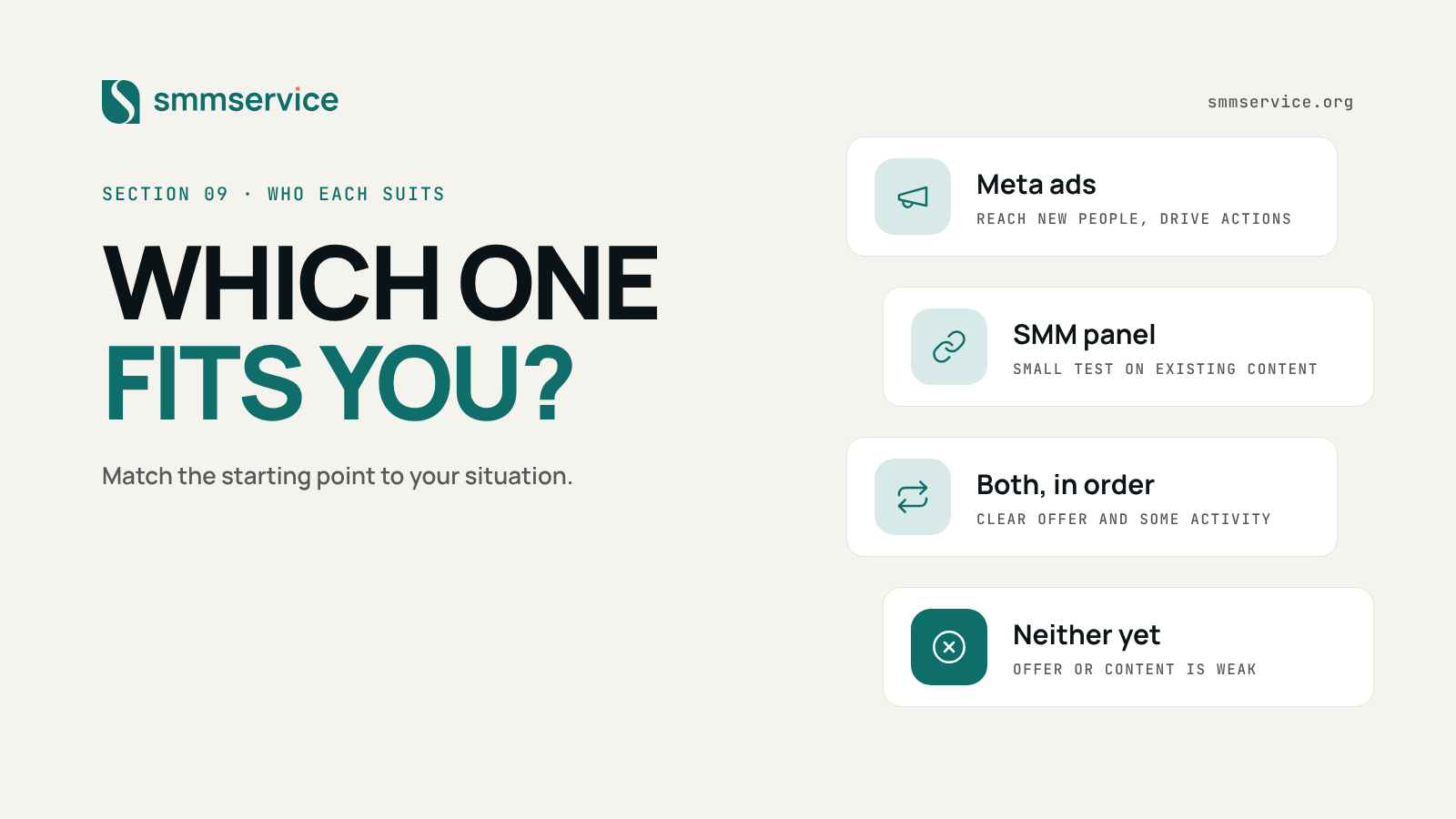
Read the table below as a starting point, then adjust it to your own goal and budget.
| Your situation | Better starting point | Why |
|---|---|---|
| You sell a product and need customers who do not know you | Meta ads | Only ads let you target new people and measure actions |
| Your new post or profile looks empty and you want a small test | SMM panel | Low entry cost, rate known in advance, easy to compare before and after |
| You want leads, bookings or sales you can trace | Meta ads | Conversion goals and reporting exist for this |
| You manage many accounts and need supply you can reuse | SMM panel | One balance for many services, with an API for automation |
| You have a clear offer and some activity on your content | Both | Ads reach new people; early activity may make the content feel established |
| Your offer or content is weak | Neither yet | Neither product fixes a weak offer |
The last row matters. Spending on either product before the offer is clear leaves you little to measure.
Using both together
Many plans combine the two, and the order matters. One common sequence is to add early activity to your content with a small panel order, then use ads to reach new people. Treat this as a suggestion to test, not a rule.
Research gives some support for the first step, with limits. A field experiment on social ads found that a single visible like raised both likes and clicks. Additional likes kept raising likes but did not raise clicks. Lesser-known brands gained more than well-known ones. The study used organic likes, not purchased ones, so it does not prove that bought activity helps ads.
Tip: test before you scale
Run a small panel order on one post and a small Meta ad set on another. Record the counts before you start and compare after 7 days. Scale only what you can explain.
A panel can also support ongoing use. Some owners add a small amount of early activity to new posts or launches, and use ads for the people they want to reach. Whether that improves ad results depends on your content and offer, so measure it rather than assume it.
A simple way to decide
Six questions are enough to reach a sensible first step. Answer them in order and write the answers down.
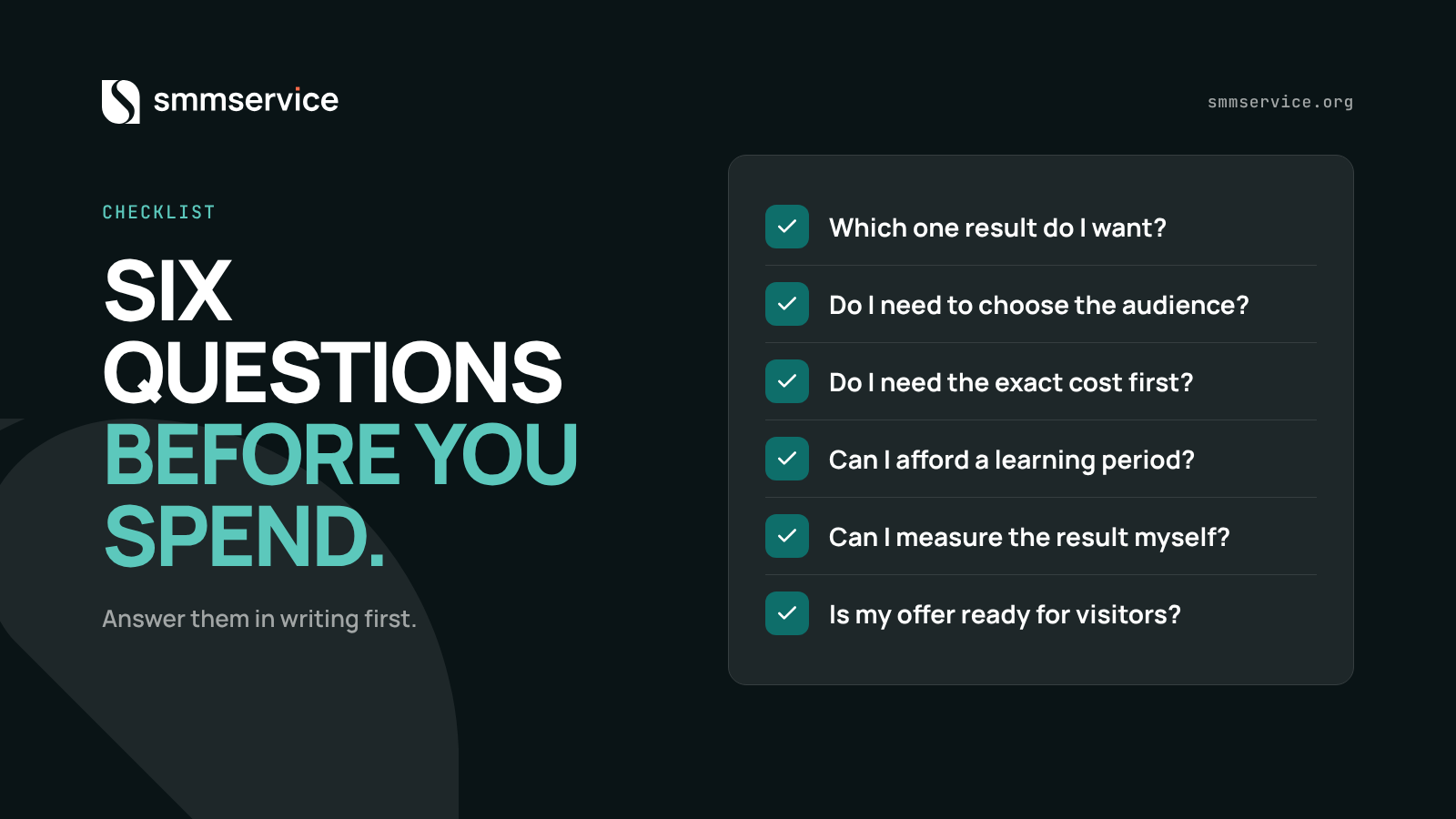
Write your answer to each question before you place any order or publish any ad.
- What is the one result I want: reach, activity on a post, leads or sales?
- Do I need to choose who sees my message? If yes, Meta ads.
- Do I need to know the exact cost before I start? If yes, a panel order has a known charge.
- Can I afford a learning period with uncertain results? If not, start smaller.
- Can I measure the result myself, with a count or a conversion?
- Is my offer or content ready for new visitors?
If your answers point to both, start with the smaller and more predictable step. A small panel order is easy to price and easy to check, and you can add a modest ad budget after you see the effect.
Where SMMService fits
SMMService is a primary provider and wholesale service supplier. It serves regular clients, business owners and other SMM panel operators. As of October 2026, the catalog lists more than 5,000 services, updated daily.
The catalog covers services across Meta-owned platforms: Instagram, Facebook, WhatsApp and Threads. Services include likes, followers, views, shares, channel and group members, reactions, saves, subscribers, custom comments, reach, profile visits, poll votes and story views. Read each service description for the details that apply to it. Current rates are on the services page.
The minimum deposit is $1. Deposits and order processing are automated, and orders are sent to the server as soon as they are placed. If you want to test before depositing, you can contact the admin or support team to ask for a free test.
On eligible services, you can click Cancel on the Orders dashboard while the status is Pending, Processing or In Progress. On refill-enabled services, the Refill button becomes available once the status reaches Completed.
Support options include live chat, direct access to the admin and an automated AI support bot. API clients also get a VIP support group with 24/7 support. Panel owners can use the v2 API with public documentation and an API key after login. They can also request custom discounted rates and child panels hosted by SMMService, where the owner keeps admin control and their customers.
Frequently asked questions
Is an SMM panel cheaper than Meta ads?
The two cost structures differ, so a direct comparison can mislead. A panel charges a known rate per 1,000 units. Meta ads charge through an auction, and the cost per result depends on your goal, audience and creative. Compare cost per outcome you care about, not the headline price.
Which is better for a new Instagram or Facebook page?
It depends on the goal. If you need people to see an offer, Meta ads can target them. If you want a small amount of visible activity on a few posts, a small panel order is a simple test. Neither fixes weak content.
Can I use an SMM panel and Meta ads together?
Yes. A common approach is to add early activity to content with a small panel order, then use ads to reach new people. Test it on a small scale and compare results before you scale.
Does a panel order replace a Meta ads campaign?
No. A panel adds activity to a link. It does not select an audience, run an auction or track conversions.
How long does a Meta ads campaign take to settle?
Meta says an ad set usually leaves the learning phase once it records roughly 50 results within a week of its latest major change. Avoid unnecessary edits during that time.
Can I cancel a panel order?
On eligible services at SMMService, a Cancel button appears while the order is Pending, Processing or In Progress. Check the service before you order.
What is drip-feed, and do I need it?
Drip-feed splits an order into runs delivered over time. It helps when timing matters, such as multi-day pacing. It does not change the quality of what is delivered.
How much should I spend on my first test?
Start with an amount you can afford to lose. For a panel, a small order is enough to compare counts. For Meta ads, Meta advises a daily budget of 10 times or more the typical cost of one result.
Conclusion and next step
Meta ads and SMM panels solve different problems. Meta ads reach defined audiences and aim at actions you can measure. A panel adds visible activity to a link at a rate you can see before you order. Choose by goal, test small, and record your numbers.
In short
Use Meta ads to reach people and drive actions. Use a panel for small, predictable amounts of activity on content you already have. Use both in order, and measure each step.
If you want to test a panel, you can create an account, make a small first order and compare your counts after 1, 7 and 30 days.
Open your wholesale account
Free to join, no monthly fee. Order in the dashboard or through the API.